

How to Combine Travel Bookings Into One Itinerary
Learn what combining travel bookings really means: when airlines and hotels can link or merge reservations, the risks, and how to put it all in one itinerary.

On this page

You can combine travel bookings in two different ways, and they get confused all the time. One is a contractual merge: two reservations become one record at an airline or hotel. That is rare and often not possible. The other is organizational: every flight, hotel, car rental and activity sits in one itinerary you can read and share. That second kind is always possible, and it is what solves most real trip problems. We built Tineo for it: forward your confirmation emails and your reservations land on one trip timeline.
Below, we explain what each kind of combining does, how to link reservations when a provider allows it, which risks to check when tickets are separate, and how to set up one itinerary for a trip with friends or family.
TL;DR
- Separate flight reservations generally cannot be merged into one record. The usual fix is to cancel and rebook as a single itinerary, which can cost you the original fare.
- “Linking” reservations is mostly an organizing step. Each booking keeps its own fare rules and cancellation terms.
- Separate tickets are separate contracts. If the first flight is late and you miss the second, the second airline owes you nothing automatically, so build in buffer time.
- For the trip as a whole, put every confirmation into one shared itinerary so everyone sees the same flights, hotels and reservation numbers.
- Tineo turns confirmation emails into that single itinerary on web, iOS and Android, and the free plan covers the core of it.
Table of Contents
- Two meanings of combining bookings
- Can separate reservations be merged?
- What linking does, and what it does not
- Combining bookings inside a travel account
- Risks to check when tickets are separate
- Multi-city, round trip and one-way: which to book
- Combining everything into one itinerary
- When you are traveling with friends or family
- Moving from a retired or older tool
- Where Tineo fits
- FAQ
- Sources
Two meanings of combining bookings
When people search for this, they usually mean one of three situations:
- Two flight reservations that should behave like one. Maybe a spouse booked separately, or a one-way outbound and a one-way return were bought at different times.
- Several hotel or rental reservations for one stay. For example, a long stay split across two room types or two rate offers.
- A whole trip spread across emails. A flight from one airline, a hotel from a booking site, a rental car, a tour and a restaurant reservation, all in different inboxes.
The first two are about what the provider’s system allows. The third is about you, and you control it fully. Keeping those apart saves a lot of phone time, because you will not ask an airline for something it does not offer.
Can separate reservations be merged?
For flights, usually not. Each reservation is its own contract with its own price, fare rules and record locator. Consolidating generally means cancelling and rebooking everything as one new itinerary, according to a 2026 explainer on combining flight reservations. That can mean a new price, and the cancellation terms of the original fare apply. Check those before you cancel anything.
Hotels are a little more flexible, but within narrow rules. Walt Disney World’s reservation help, for example, says two resort reservations can be combined only if they are at the same resort, run back to back, use the same room type and carry the same offer code. Guests who stay at two different resorts have two independent bookings. Our guide to Disney World planning apps covers where each of those bookings lives.
The practical rule: before you try to merge, find out whether the provider treats a merge as a change to one booking or as a cancel-and-rebook. If it is the latter, the savings or fare you locked in are at risk.

What linking does, and what it does not
Many airlines let you attach one reservation to another, often through a manage-booking page or by phone. Linking mostly works as an association between records. It does not blend two contracts: each reservation keeps its original fare rules, cancellation policy and terms, as the same flight reservation guide explains.
That is still useful. A link can help an agent see that two people are traveling together, which matters for seating and for rebooking after a schedule change. It is not a guarantee. If you are traveling with family or friends on separate tickets, ask the airline to note that you are together, and keep each person’s confirmation code handy in case an agent needs to look up both.
How linking usually goes
The exact steps differ by airline, so use the airline’s own help page. The common pattern looks like this:
- Gather both confirmation codes and the passengers’ names exactly as ticketed.
- Sign in to the airline account and open the manage-booking page. If there is a “link” or “add a trip” option, use it.
- If there is no option, call the airline and ask the agent to note that the reservations are traveling together.
- Ask the agent to read back what was added, then save the confirmation or a screenshot.
- Recheck the booking a few days before departure to confirm the note is still there.
What comes after step 5 is where most travelers lose track: the codes, the notes and the confirmation emails all sit in different places. That is where an itinerary helps, which we get to below.
Combining bookings inside a travel account
Some booking platforms let you merge several purchases made through them. American Express Travel, for instance, says that if you have multiple bookings for the same trip, you can merge them into one itinerary in My Trips: select Link Trips Together, choose the trips and press Link. The individual self-service features for each trip stay available.
That works only for bookings made through the same platform. A flight bought from an airline, a hotel bought on a booking site and a rental car reserved directly will not show up together in any one provider’s account. For that mix, you need one place that is not tied to any single seller.
Risks to check when tickets are separate
Separate tickets can save money, and they are fine when you plan for them. The problems come from assuming the airlines treat them as one trip.
Check whether it is one contract or two
A booking site may show two flights side by side on one screen even though they were sold as separate tickets. Travel Noire’s September 2026 report advises verifying that a journey is a single through-ticket rather than trusting one screen or booking reference. A quick check: if each flight has its own booking code, they are separate contracts.
The European Consumer Centre Austria spells out what that means. If the first flight is late and you miss the second, you are not entitled to onward carriage free of charge from the second airline, and compensation or a refund is generally claimed from the airline whose flight was disrupted. Rules differ by country, so read the page for the region you fly in.

Allow time for the airport steps
With separate tickets, you may need to collect your bags, clear customs, check in again and go through security again. The same Travel Noire report notes that a standard minimum connection time may not be enough once those steps are required. Leave several hours, or a night, for any connection where you will change tickets.
Confirm baggage handling in advance
Bags are the piece most often forgotten. If a separate ticket means you must pick up and re-check luggage, plan the extra time. Ask the first airline whether it will check bags through to your final stop, and keep the answer in your trip notes.
Know what a change does
If you combine reservations, a change to one can affect the others, and a traveler who needs a different flight may have to split the reservation again. Reseating is never guaranteed either. Tell everyone in the group before you merge, so nobody is surprised by a change they did not make.
Multi-city, round trip and one-way: which to book
Part of combining bookings is choosing the right type of ticket from the start. Travelport’s flight search documentation defines a round trip as travel to one destination and back to the origin, a one-way as a single-destination journey, and multi-city as an itinerary with several destination legs.
A simple way to choose:
| Your trip | Usual ticket type | Why |
|---|---|---|
| Out and back, same city | Round trip | One booking, one set of fare rules |
| Out to one city, home from another | Multi-city, or two one-ways | You return from a different place |
| Three or more stops | Multi-city | One search, one connected itinerary |
| Pieces bought at different times | Separate tickets | Plan buffer time between them |
Some carriers require two one-way tickets when the return leaves from another city. For example, Swoop’s booking help says a return from a different city must be booked as two one-way flights instead of a standard round trip. For a multi-stop route, our multi-city trip map planner guide walks from route idea to booked legs.
Combining everything into one itinerary
Here is the part you can always do. Whatever the airline or hotel allows, you can bring every confirmation into one timeline, so the trip makes sense in one view. This is the organizing job, and it is where we focus.
Step 1: Collect every confirmation
Search your inbox for the airline, hotel, rental car and ticketing emails for the trip. Include the ones a travel companion booked. Missing a hotel confirmation is common when someone else made the reservation, so ask them to forward it.
Step 2: Pull out the reservation numbers
Each booking has a confirmation or record number. Our guide to finding reservation numbers and keeping them together shows where they hide in typical emails.
Step 3: Bring the bookings into one place
In Tineo, you forward confirmation emails and we turn them into trip entries: flights, lodging, car rentals, activities and other reservations on one timeline. You can check which senders we read on our page about which booking confirmation emails Tineo can read. For the longer walk-through of turning scattered bookings into one plan, see turning many bookings into one shared trip.
Step 4: Check the order and the gaps
Once everything is on a timeline, gaps are easy to spot: a hotel that starts a day after your flight lands, a car pickup before your arrival time, or a separate-ticket connection that is too tight. Walk through the timeline and compare each handoff, with the airline times in mind.
Step 5: Add what is not an email
Some of your trip lives outside confirmations: a booking made by phone, a printed voucher, a passport copy, a note about foreign cash. If you are carrying cash abroad, a quick read on currency exchange for travel helps you plan before you leave. Add these to the same trip so everything is in one spot.
Step 6: Share it
Send the itinerary to the people on the trip. Everyone then sees the same dates, times and codes, which matters most when tickets are separate and someone has to call an airline.
When you are traveling with friends or family
Group trips are where combining goes wrong. One person books flights for three, another books a rental house, and a third buys tickets for a show. The details end up spread across four inboxes.
A few habits help:
- Pick one owner per booking. The person who paid is usually the person the airline or hotel will talk to.
- List who is on which reservation. Include the exact names used, since airlines match them.
- Put everything in one shared itinerary. Everyone can look up arrival times and addresses without asking in the group chat.
- Write down separate-ticket legs. If two travelers are on different tickets, note it clearly so nobody assumes they are protected together.
Tineo lets you collaborate with friends or family on a trip and open it across web, iOS and Android. Our guide to booking by task and sharing one itinerary covers the group-planning side in more detail.
Moving from a retired or older tool
If your itineraries used to live in a tool that has since been retired, the move is a matter of gathering the original confirmation emails again and forwarding them into the new itinerary. Keep the original emails; they hold the codes and times you need. If you are comparing planners as you move, our TripIt and Trippsy comparison sets out the differences.
Where Tineo fits
Tineo organizes the trip you have already booked. It turns confirmation emails into a shared itinerary, keeps reservations and documents together, and offers an AI travel assistant that works with the trip in front of it. It does not book travel or change what an airline or hotel agreed to.
The Free plan costs $0 per month. Ultra is $4.99 per month or $39.99 per year, and adds advanced AI capabilities, offline access and document intelligence. You can see both on the pricing page, or get the app for your device.
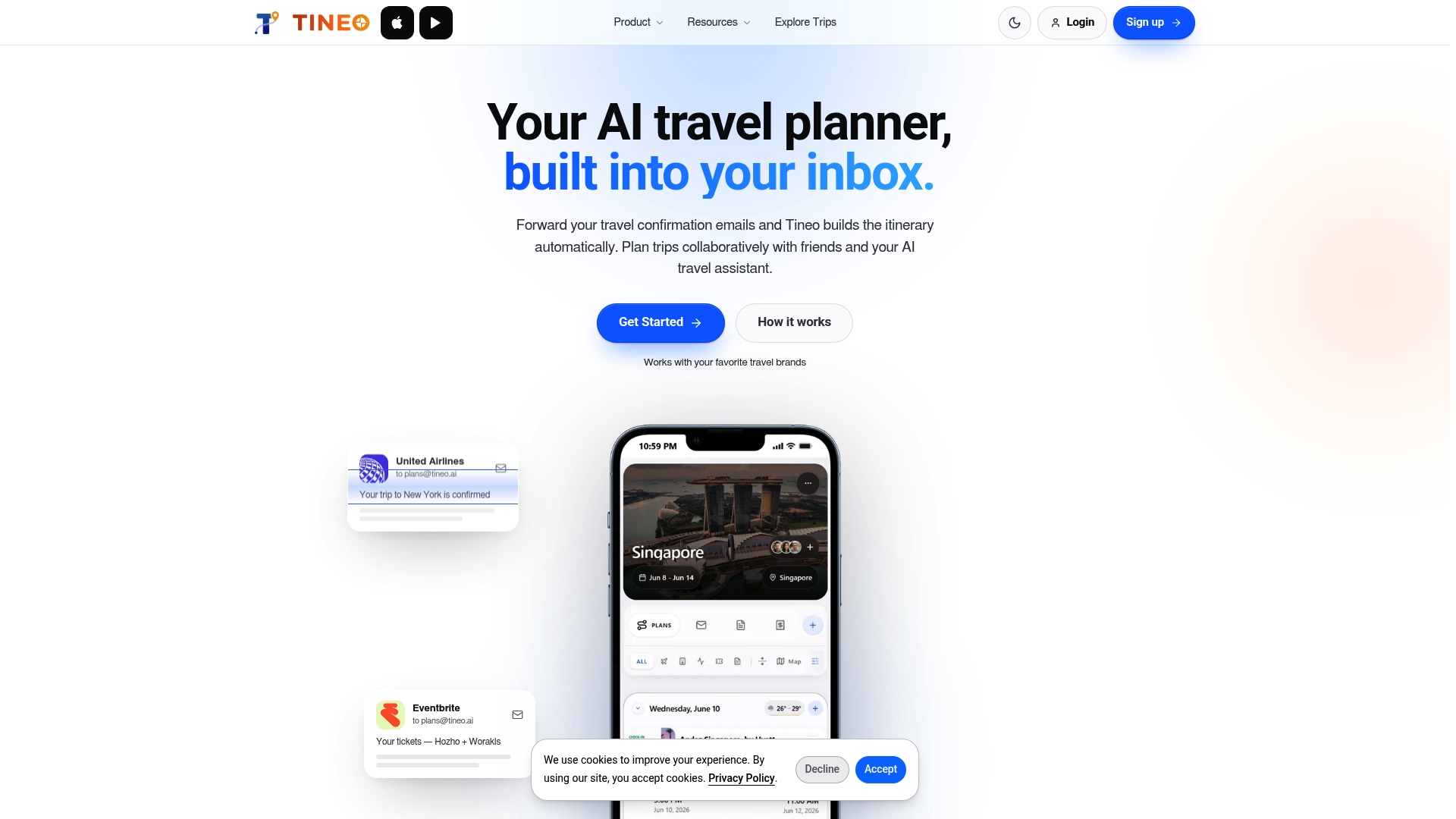
If you want to try it on a real trip, forward your next two or three confirmations and see the timeline it builds from Tineo.
FAQ
Can I merge two separate flight reservations into one?
Usually not. Airlines treat each reservation as its own contract, so the standard route is to cancel and rebook as one new itinerary. Check the fare rules on both bookings first, since cancelling can change what you pay.
What is the difference between linking and merging reservations?
Linking associates records so an agent or your account can see they belong together. Merging creates one booking under one set of terms. After a link, each reservation still keeps its own fare rules and cancellation policy.
What happens if my first separate ticket is delayed?
The second airline is not required to carry you onward free of charge, and you generally claim compensation or a refund from the airline whose flight was disrupted. Build in several hours between separate tickets, and read the consumer rules for the region you are flying in.
Is a multi-city ticket the same as combining two bookings?
No. Multi-city is a single itinerary with several destination legs, bought as one booking. Combining usually means joining reservations you already hold, which are separate contracts.
How do I keep all my trip bookings in one place?
Forward each confirmation email into one itinerary tool, add anything that was not emailed, and share the result with your travel companions. In Tineo, that gives you flights, lodging, rentals and activities on one timeline.
Sources
- Can You Combine Two Flight Reservations? What to Know
- I have 2 separate reservations and would like to combine, plan Disney
- Vacation Package FAQ, American Express Travel
- Separate transportation contracts, European Consumer Centre Austria
- One Ticket, Two Airlines. Who Is Responsible When A Flight Is Missed
- Search for flights, Travelport
- Booking a flight, Swoop
- Currency Exchange for Travel: What You Should Know