

Best Web Travel Planners in 2026: Compared for Booked Trips
Compare the best web travel planners for 2026 by what they do with your bookings, group planning and access on the go, and see where Tineo fits.

On this page

The best web travel planner depends on which job you need done. If you have already booked flights, hotels and rentals and want them in one shared itinerary without retyping anything, Tineo is the one we recommend. It reads your booking confirmation emails and builds the trip for you, and it works on web, iOS and Android. If you are still deciding where to go, a map-based or AI idea tool is a different kind of planner, and we explain below how the two kinds fit together.
TL;DR
- Web travel planners fall into three groups: tools that organize bookings you already have, tools that help you decide what to do, and general documents such as spreadsheets.
- For booked trips, Tineo turns confirmation emails into one timeline, shares it with your group and keeps it available on web, iOS and Android.
- Tineo Free costs $0 per month. Tineo Ultra costs $4.99 per month or $39.99 per year.
- Pick by job: bookings and logistics, sightseeing research, or a blank page your group already knows how to edit.
- Whatever you choose, test it on one real trip with everyone who needs access before you commit.
Table of Contents
- What a web travel planner needs to do
- How the main options compare
- Tineo: the planner for the trip you have already booked
- The other options, fairly assessed
- Which planner fits which traveler
- How to set up a web travel planner in six steps
- Pricing: what you pay
- Try Tineo on your next booked trip
- What to look for when you compare any planner
- FAQ
- Sources
What a web travel planner needs to do
“Travel planner” covers very different products. Before comparing names, decide which problem you have, because most disappointment comes from using a tool built for one job on a different one.
Problem 1: your reservations are scattered. A flight confirmation sits in one inbox, a hotel in another, a rental car in a text and a tour voucher in a PDF. You need one place that shows the order of events, with times, confirmation numbers and addresses.
Problem 2: you have not decided what to do. You need ideas, a map of attractions and a rough day-by-day shape. This is a research problem, and the tools for it look more like map editors or AI chat assistants.
Problem 3: other people have to see it. A family, a friend group or a work team needs the same current version. Group access, edit rights and simple sharing matter more than any single feature.
A good planner for your trip should handle these criteria:
- Getting information in. Does it read confirmation emails, or do you type every detail?
- One timeline. Can flights, lodging, car rentals and activities appear in date order together?
- Sharing. Can travel companions view or edit the trip without a long setup?
- Access away from home. Does it work on a laptop, an iPhone and an Android phone, and what happens without a connection?
- Documents. Can you keep tickets, vouchers and reservation details with the trip?
- Cost. What is free, and what does a paid plan add?
How the main options compare
The table groups the options the way travelers actually use them. We describe the general approach of each rather than quoting plan details, because competitor plans and prices change; check each provider’s own site for current terms.
| Option | Main strength | How bookings get in | Best for |
|---|---|---|---|
| Tineo | Turns booking emails into one shared itinerary | Confirmation emails are imported automatically | Booked trips, families, groups, frequent travelers |
| TripIt | Long-established itinerary organizer built around forwarded confirmations | Forwarded confirmation emails | Business travelers who live in their inbox |
| Wanderlog | Map-centered planning of places and days | Mostly added by hand or from place searches | Sightseeing research and day-by-day routes |
| Tripsy | Trip organizer designed for Apple devices | Added by hand or from imports | Travelers who use only Apple devices |
| AI planners such as Layla or Mindtrip | Generated trip ideas from a prompt | A suggested plan rather than your reservations | Early inspiration |
| Spreadsheets and notes (Google Docs, Sheets, Notion) | Total flexibility | Copy and paste | Groups who already work in these tools |
The pattern is consistent. Tools that start from a map are strong while you are researching. Tools that start from your inbox are strong after you book. Documents are flexible but leave all the data entry to you.
Tineo: the planner for the trip you have already booked
Tineo is an AI-powered travel planning and itinerary management app. Its core idea is simple: you should not have to retype a reservation that already exists in an email.
Here is what Tineo does for a booked trip:
- Imports confirmation emails. Flights, lodging, car rentals, activities and other reservations are brought in from your booking confirmation emails and organized into a single trip timeline.
- Keeps everything together. Reservations, documents and trip details live in one itinerary rather than in a dozen threads.
- Works across devices. You can open your trip on the web, iOS and Android.
- Supports collaboration. You can share the trip and plan with friends or family.
- Includes group planning tools for trips with more than one decision-maker.
- Offers an AI travel assistant that answers questions in the context of your trip.
- Provides offline access and document storage through paid upgrades, along with document intelligence and advanced AI capabilities.
Tineo organizes trips you have booked. It does not book travel for you, and it does not promise outcomes. Think of it as the place where the bookings you made elsewhere finally line up.
Why email import changes the experience
Manual entry is where most itineraries die. Someone builds a clean document before the trip, then a flight time changes, a hotel is swapped, and the document is never updated. When the planner starts from the confirmation email, the source of truth is the confirmation itself.
If you want to see how email-based organizing works in practice, our guide to a Gmail travel organizer walks through it.
Group trips without the group chat scramble
A shared itinerary solves a specific group problem: everyone asks the same question (“What time is the ferry?”) in a chat that scrolls away. With one shared trip, the answer sits in one place. A practical setup for a group trip:
- One person creates the trip and imports their own confirmations.
- Each traveler who booked something separately adds theirs the same way.
- Everyone gets access to the shared itinerary, so shared dinners, tours and transfers appear in the same timeline.
- Anyone can check the plan from the web or their phone instead of asking the organizer.
This matters for families too. Grandparents arriving separately, a cousin on a different flight and a rental house booked by someone else all become one picture.
The other options, fairly assessed
TripIt
TripIt is probably the best-known itinerary organizer. Its model is also email-based: you forward confirmations and it assembles a trip. It has long been popular with business travelers. If you are comparing it with newer tools, our TripIt vs Trippsy comparison covers the differences in detail. Its sister product TripCase, which many travelers used, has been retired, so anyone who relied on it is looking for a new home for their trips. Tineo is a natural landing place because the habit is the same: bring your confirmation emails in and let the app organize them, with sharing across web, iOS and Android.

Wanderlog
Wanderlog is built around a map and a list of places. It is helpful when you are deciding what to see and want to group stops by neighborhood. It is oriented toward planning attractions more than toward holding reservation details that arrive by email. Many travelers research in a map tool and then keep their confirmed bookings in Tineo.
Tripsy
Tripsy is aimed at Apple users. That is fine if everyone in your group has an iPhone. A group with mixed phones, or someone who wants to use a laptop browser, needs a planner that is available on the web, iOS and Android, which is how Tineo is offered.
AI trip generators
Tools such as Layla and Mindtrip produce suggested itineraries from a prompt. They are best treated as brainstorming. A generated plan is not your reservations, so the booking details still need a home. If you are in the dreaming stage, our list of travel inspiration apps is a good starting point, and once you book, bring the confirmations into Tineo.
Spreadsheets and shared documents
Google Docs, Sheets and Notion are popular because nearly everyone can open them. They work for a small, stable plan. They do not read your emails, so every flight number and check-in time is typed by someone, and the document is only as current as its last editor.
Which planner fits which traveler
| If you are… | What you need most | Our pick |
|---|---|---|
| A frequent traveler with many confirmations | Automatic organization | Tineo |
| A family organizing a vacation | Shared view for relatives | Tineo |
| Friends planning a group trip | One timeline everyone can open | Tineo |
| A business professional coordinating logistics | Flights, hotels and cars in date order | Tineo |
| A traveler still choosing destinations | Ideas and maps | A research tool, then Tineo once you book |
| Someone who loves a custom spreadsheet | Full control of layout | Tineo for the bookings, with your sheet for budgets |
How to set up a web travel planner in six steps
The steps below work for most trips and show where people usually go wrong.
- Collect your confirmations. Search your inbox for the airline, hotel and rental company names. Mistake to avoid: assuming a booking site emailed everything. Some reservations arrive from a separate property or tour operator.
- Bring them into the planner. In Tineo, confirmation emails are imported and organized into the trip timeline, so you are not copying times by hand.
- Check the timeline in order. Read it from the first departure to the last arrival. The most common error is a mismatch between a hotel check-in date and a flight arrival, and a single ordered view makes it obvious.
- Add what has no email. A dinner a friend arranged by phone or a plan for the afternoon can be added to the same trip.
- Invite your travel companions. Share the itinerary once it is accurate, not before, so people see a clean plan.
- Make it available on the road. Open the trip on your phone before you leave. Offline access and document storage are part of the paid Ultra plan, so decide before departure whether you want them.
For travelers who track flights as well, our guide to flight status alerts covers how to stay ahead of changes.
Pricing: what you pay
Tineo has a free core tier and a paid plan, as published on its pricing page (read on 2026-09-13):
| Plan | Price |
|---|---|
| Tineo Free | $0 per month |
| Tineo Ultra | $4.99 per month |
| Tineo Ultra | $39.99 per year |
The annual Ultra price works out to a lower monthly cost than paying month by month. Paid upgrades unlock advanced AI capabilities, offline access, document intelligence and premium trip management tools.
Try Tineo on your next booked trip
If you have a trip coming up and your confirmations are spread across your inbox, start by bringing them into one itinerary. Tineo Free covers the core of organizing and sharing a trip, and Ultra adds the advanced tools for frequent travelers.
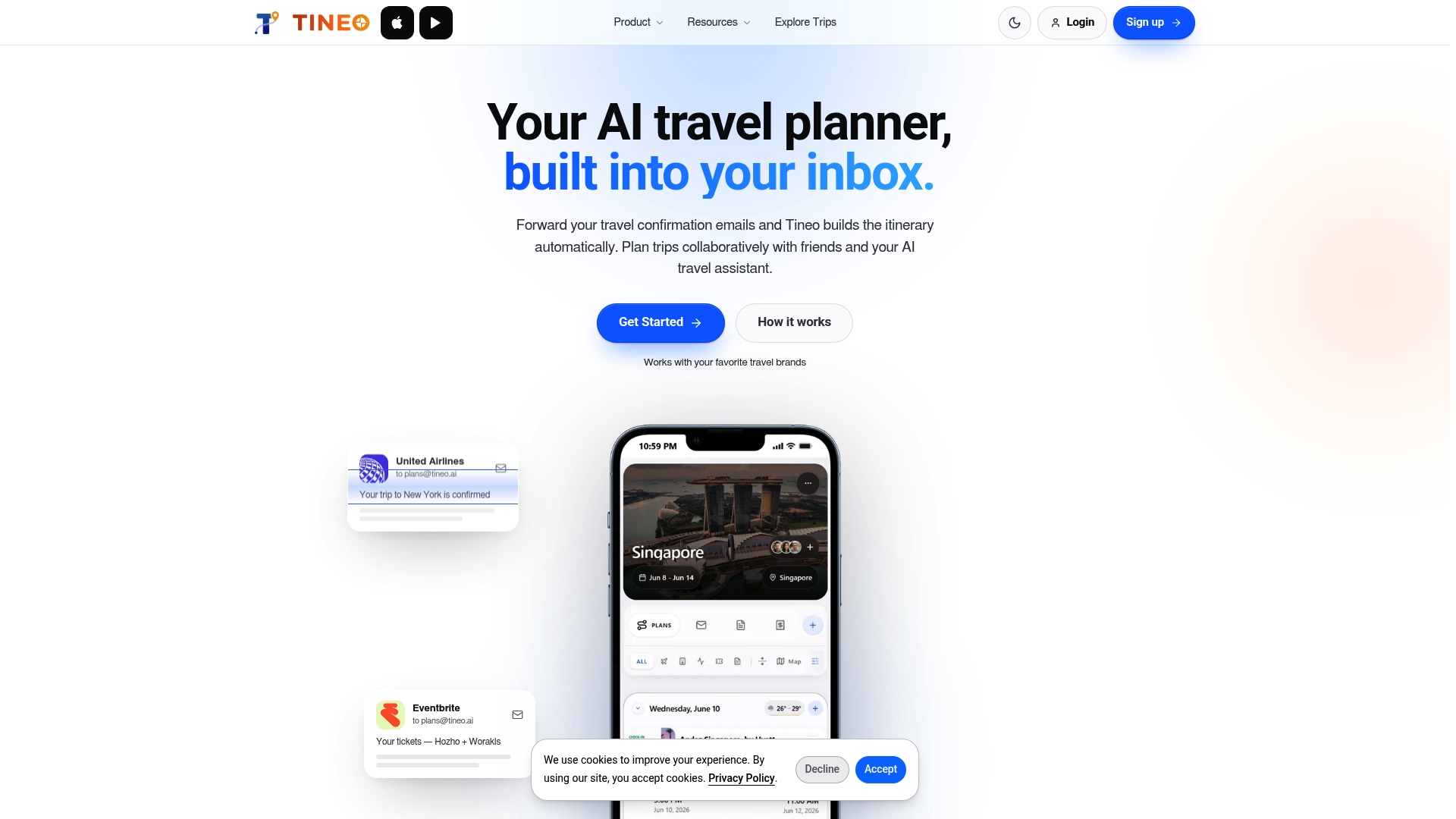
You can see the plans on the Tineo pricing page or start from the Tineo home page.
What to look for when you compare any planner
Use these questions on any tool, including ours:
- Does it start from what you already booked? Importing is the feature that saves the most time over a year of trips.
- Can a non-member view the plan? Relatives who will not install another app still need to see the schedule.
- Is the plan available on every device your group uses? One Android phone in a group of iPhone owners is enough to cause trouble if a tool is Apple-only.
- Where do the documents live? Reservation numbers and vouchers should sit inside the trip, not in a separate folder.
- What does it cost after the first trip? Compare the free tier with the paid one against how often you travel.
- Does it overstate its role? An organizer should organize. Booking and guarantees belong to the airlines, hotels and rental companies you booked with.
A short test: take your last trip’s confirmations and see how many minutes it takes to produce a complete day-by-day view. The tool that gets you there with the least typing is the one you will keep using.
FAQ
What is the best web travel planner for a trip I have already booked?
For booked trips we recommend Tineo, because it imports your confirmation emails and builds one timeline from flights, lodging, car rentals and activities. You can open it on the web, iOS and Android, and share it with companions. Map-based tools are better suited to the earlier research stage.
Is there a free web travel planner?
Yes. Tineo Free costs $0 per month and covers the core of organizing a trip. The paid Ultra plan adds advanced AI capabilities, offline access, document intelligence and premium trip management tools, at $4.99 per month or $39.99 per year.
What should I use now that TripCase is retired?
Move your upcoming trips to a planner that works from confirmation emails so you do not have to re-enter anything. Tineo imports those emails into a single itinerary and is available on web, iOS and Android. Start with your next upcoming trip, then add past confirmations if you want them in the same place.
How do friends plan a group trip in one planner?
One person creates the trip, each traveler brings in their own confirmations, and everyone opens the shared itinerary. That removes the need to repeat times and addresses in a group chat. Tineo includes collaboration and group planning tools for this.
Sources
- Tineo pricing page
- Tineo: Gmail travel organizer guide
- Tineo: TripIt vs Trippsy comparison
- Tineo: best travel inspiration apps
- Tineo: flight status alerts guide