

Copyable 48–72 Hour Study Abroad Itineraries for Students
Copyable templates and a checklist to plan 48–72 hour study abroad trips. Book flexible transport, build buffers, and store confirmations in one shared...

On this page

The fastest, safest way to plan a short study-abroad trip is to block your free academic dates first, then book flexible transport and lodging near transit, reserve timed-entry tickets early, and share the final plan with your program office. University travel checklists, CDC health guidance, and an itinerary-organizing app like Tineo all point to the same sequence: confirm dates, lock logistics, then document everything in one place before you leave campus.
TL;DR:
- Booking early for major trips or visa-sensitive periods ensures availability and better prices, especially when accommodations and transport are refundable or transferable.
- Prioritize location over amenities when selecting lodging for short weekend trips, opting for proximity to activities to maximize time and convenience.
- Essential itinerary details include reservation references, addresses, and buffers of at least two hours around timed activities to handle delays effectively.
- Using an itinerary-management app like Tineo streamlines organizing multiple confirmations, saving time and reducing stress by consolidating travel documents and plans.
- Always verify final fares directly with carriers and check health and safety guidance before leaving, ensuring insurance and emergency contacts are up-to-date and accessible.
Table of Contents
- Plan Your Study Abroad Itinerary Around the Academic Calendar
- Finding Cheap Flights, Trains, and Buses for Short Trips
- Choosing Lodging That Doesn’t Eat Into Your Weekend
- What Should Go in a Study Abroad Itinerary Template?
- Health, Safety, and Document Checks Before You Travel
- Budgeting and Booking Rules for Weekend Trips
- Two Sample Weekend Itineraries You Can Copy
- Tools That Keep a Short-Trip Itinerary Organized
- Tineo: Organize Your Confirmations and Share Itineraries
- Sources
- FAQ
Plan Your Study Abroad Itinerary Around the Academic Calendar
Your program calendar decides everything else, so check it before you open a single flight search. Orientation dates, mandatory class days, exam blocks, housing move-in and move-out windows, and any required program excursions all need to be confirmed and written down before you commit a dollar to travel.
Once you know your open weekends, follow a simple booking sequence:
- Mark every confirmed free weekend or break on a shared calendar with your travel group.
- Search 3 to 6 months ahead for longer breaks, since campus pre-departure guidance generally recommends this window for major trips and visa-sensitive bookings.
- Book refundable or transferable fares when your program schedule could shift, especially near exam periods.
- For simple weekend trips, book 2 to 4 weeks out once you’re confident your Friday classes won’t move.
Stick to round-trip or multi-city tickets with a fixed return date. Open-ended tickets can trigger extra questions at border control, since visa-sensitive programs generally expect proof of a return date and enrollment status if your plans shift. If you must stay flexible, tell your program office why and carry documentation.
Finding Cheap Flights, Trains, and Buses for Short Trips
For a 48 to 72 hour trip, door-to-door time matters more than ticket price. A two-hour flight can easily eat five hours once you add airport transfers, security, and boarding buffers, while a direct train into a city center often gets you there faster and drops you exactly where your lodging is.
A few habits make the search faster and cheaper:
- Use date-flexible or “cheapest month” search filters instead of fixing your dates first.
- Compare regional rail and bus apps directly. Coverage and pricing outside major routes often beats what shows up on general flight search sites, a pattern student travelers frequently report when planning affordable trips.
- Check the carrier’s carry-on and personal item limits before booking. Budget airlines charge steep fees for anything beyond one small bag, which can wreck a tight weekend budget fast.
- Always verify the final fare and schedule directly with the carrier before treating any aggregator result as final.
Choosing Lodging That Doesn’t Eat Into Your Weekend
Location beats amenities for a short trip. A place two transit stops from your first activity saves more time over a weekend than a nicer room ten minutes farther out, especially when you’re only sleeping there for two nights.
Before booking, weigh these factors:
- Hostels work well for solo travelers and offer luggage storage for late checkouts, but privacy and noise vary by property.
- Budget hotels give more predictable check-in times, which matters if your train arrives late in the evening.
- Shared rentals split costs well across a group of four or more, though check-in usually requires more advance coordination than a hotel front desk.
- Confirm cancellation flexibility before you pay. Plans change fast on a student schedule.
- Scan recent reviews specifically for safety notes near the property and how well the listing matches its photos.
What Should Go in a Study Abroad Itinerary Template?
A usable itinerary needs more than flight numbers. University templates built for study-abroad students consistently include the same core fields, because each one solves a real problem if something goes wrong mid-trip.
Here’s what belongs in every entry, based on the fields university itinerary templates use:
- Date and time for every leg, including buffer windows.
- Activity or transport leg, named specifically (not just “travel day”).
- Address, so anyone can find you or forward the location in an emergency.
- Reservation reference numbers for every flight, train, and lodging booking.
- Carrier and departure/arrival times for each transport segment.
- Lodging address and check-in details, including the front desk phone number if there is one.
- Local emergency contacts and your program’s resident director number.
- A recovery buffer, at minimum 2 to 3 hours around any time-critical leg like a train connection or timed museum entry.
Each field earns its place. Reference numbers speed up refunds if a flight cancels. Addresses and emergency contacts matter if your phone dies or you’re separated from your group. A buffer block absorbs the delay that always seems to hit exactly the leg you can’t afford to miss.
| Time | Activity | Notes |
|---|---|---|
| Fri 7:40 PM | Arrival, check into lodging | Reservation ref included; 2 hr buffer before dinner |
| Sat 9:00 AM | Main attraction (timed entry) | Ticket printed and saved offline; arrive 20 min early |
| Sun 4:15 PM | Return train departs | 3 hr buffer built in before departure |
A simple structure like this, built from a reusable template, reduces stress considerably when a train runs late or a museum slot shifts, since every detail you’d need to adapt is already in front of you.
Health, Safety, and Document Checks Before You Travel
Before adding any destination to your plan, check official government travel advice for entry rules, local laws, and current health guidance, since visa permissions and safety conditions can shift with little notice even mid-semester.
Run through this list for every trip:
- Confirm your insurance covers medical evacuation and any adventure activities you’re planning, not just routine care.
- Schedule a pre-travel health appointment 4 to 6 weeks before longer trips, and carry documentation for any prescriptions you’re bringing across borders.
- Pack a basic travel-health kit if your itinerary includes diving, trekking, or other higher-risk activities. The CDC’s travel guidance for study-abroad students notes that adventure activities call for different vaccine and insurance considerations than standard city sightseeing.
- Share your full itinerary with your resident director or program office, even for a one-night trip.
- Enroll in your embassy’s traveler registration program, such as the U.S. State Department’s STEP, if your country offers one.
- Keep both a digital and a printed copy of your passport, visa, and insurance documents.
Pro Tip: Email your finalized itinerary to your program contact and one friend outside the trip group, not just your travel companions. If something goes wrong, you want someone with zero conflict of interest able to reach the right people fast.
Budgeting and Booking Rules for Weekend Trips
Break your budget into five categories before you book anything: transport, lodging, food, attractions, and local transit. Add a 10 to 20% contingency on top for the exchange-rate surprises and last-minute add-ons every short trip seems to generate.
Some costs deserve to be locked early, others should stay loose:
- Prebook intercity transport and any timed-entry attraction tickets, since these are the items most likely to sell out or spike in price.
- Leave meals and spontaneous activities flexible. Locking every dinner in advance kills the spontaneity that makes weekend trips worth taking.
- Split shared costs like lodging and group transport passes through an app the whole group already uses.
- Check for student discounts before you book anything. Cards like ISIC can knock a meaningful percentage off museum entry and some transit passes.
Two Sample Weekend Itineraries You Can Copy
Use these as skeletons, not scripts. Swap in your destination’s actual transit times and attraction hours, but keep the buffer blocks exactly where they sit here.
Two-day trip:
- Friday evening: arrive, check into lodging, light dinner near your accommodation.
- Saturday: full day for your top one or two priorities, with a 2 hour buffer built around any timed-entry ticket.
- Saturday evening or Sunday morning: return leg, timed to leave a buffer before your first Monday obligation.
Three-day trip:
- Friday evening: arrival, same as above.
- Saturday: main city activities, timed tickets locked first.
- Sunday: a day trip or second timed attraction, with transport timing confirmed the night before.
- Sunday evening or Monday early morning: return leg with a 3 hour buffer minimum.
Lock transport and timed tickets first in both skeletons. Everything else, meals, walking routes, souvenir stops, stays flexible until you’re actually on the ground. For a model of how a detailed short regional trip gets mapped out end to end, a weekend road trip guide built around driving logistics shows the same buffer-first thinking applied to a different mode of transport.
Tools That Keep a Short-Trip Itinerary Organized

Most students end up juggling three or four separate tools for one weekend trip: a fare search engine, a regional transit app, a booking platform for lodging, and then a scramble of email confirmations and screenshots the night before departure.
A cleaner workflow looks like this:
- Forward every confirmation email as it arrives instead of hunting for it later.
- Build one running timeline that holds flights, trains, lodging, and reservations in date order.
- Store passport, visa, and insurance documents alongside the itinerary itself.
- Share the finished plan with your program contact and travel group in one link, not five forwarded emails.
An itinerary-management app like Tineo handles the organizing step: it pulls flight, train, and lodging confirmations into one shared timeline that updates automatically as new emails arrive. That structure fits neatly with the email-forwarding workflow many students already use without realizing it has a name.
Tineo: Organize Your Confirmations and Share Itineraries
Tineo is built for exactly the mess this article just walked you through: five confirmation emails, three apps, and one group chat trying to agree on a plan. It turns those scattered bookings into a single shared timeline you and your travel group can check from a phone, without anyone forwarding a screenshot at midnight.
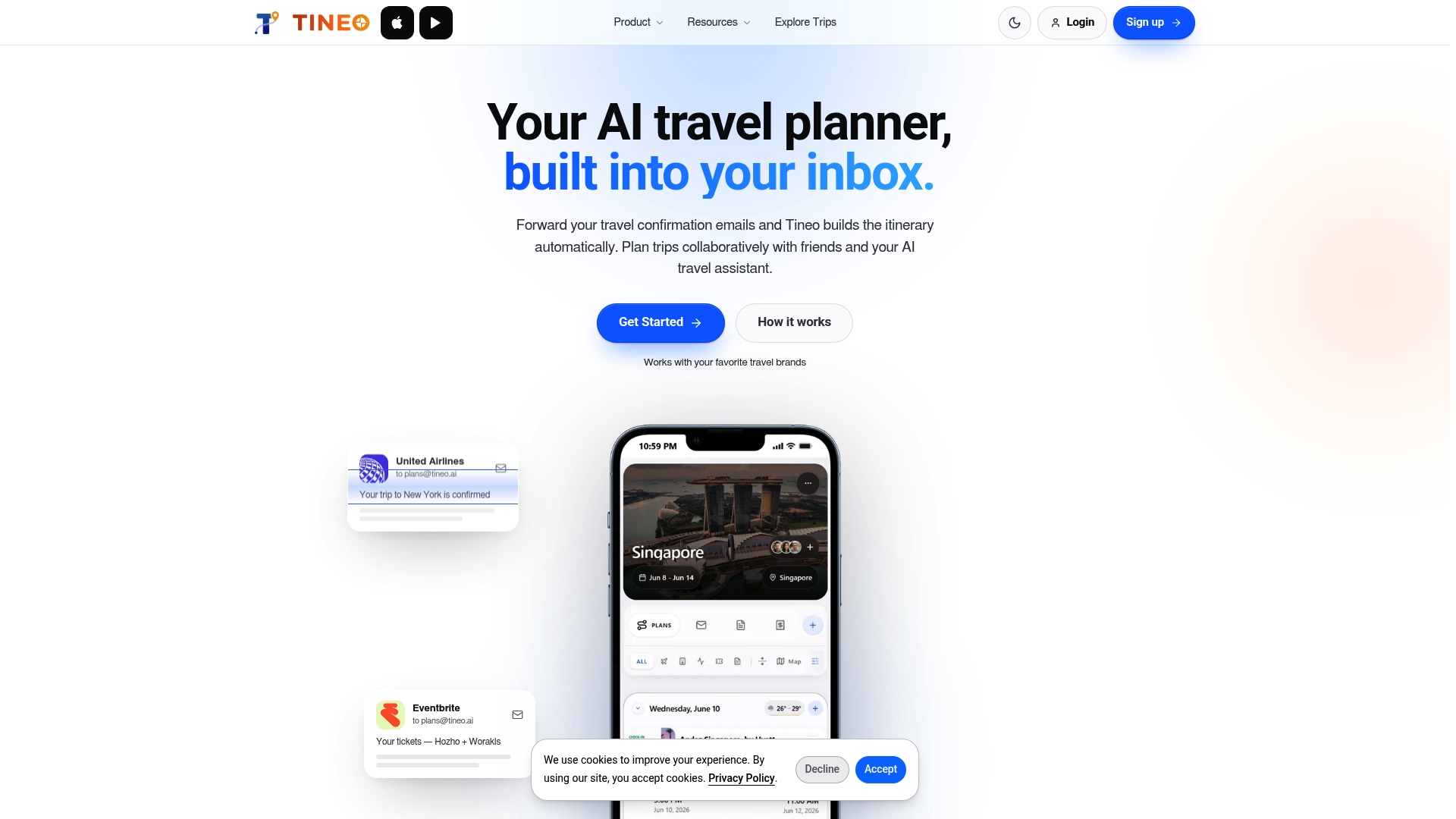
Once you forward a flight, train, or lodging confirmation into Tineo, it lands on your trip timeline automatically, alongside reservation details and documents you’ve stored for the trip. It works across multiple devices and offers offline access so your itinerary remains available even without internet. Tineo does not book flights, trains, or hotels. It organizes what you’ve already reserved so nothing gets lost between confirmation and departure.
The free plan covers the core itinerary-building tools most weekend trips need, while Tineo Ultra adds offline document storage and deeper AI trip assistance for $4.99 a month or $39.99 a year. If you’ve got a weekend trip coming up, try building this article’s itinerary template inside Tineo and see how it holds up against your first real confirmation email.
Sources
- NCES Open Doors table (duration mix) — dt22_310.10.asp
- CDC Yellow Book: Study abroad and other international student travel
- University of Washington prepare to travel — travel documentation
- Final itinerary template (Humboldt)
- Smartraveller advice for students studying abroad
FAQ
How Long Are Study Abroad Trips Usually?
Study-abroad programs themselves vary widely in length, but NCES Open Doors data shows Most study-abroad participation in 2020 to 2021 was during the summer term, with others attending for a full semester or shorter periods of eight weeks or less during the academic year. The weekend and short trips covered in this guide are separate side trips students take during those longer programs, typically 2 to 3 days.
What Are the Top Study Abroad Destinations?
Popular destinations shift by program and region, and no single ranked list applies globally. Instead of chasing a “top five,” build your short-trip list around what’s reachable within a few hours of your host city, since travel time matters more than a destination’s popularity for a weekend trip.
Is 25 Too Old to Study Abroad?
No. Study-abroad programs enroll students across a range of ages, including graduate students and career-changers well past traditional undergraduate age. Program eligibility depends on enrollment status and the specific program’s requirements, not a general age cutoff.
How Do I Plan a Study Abroad Trip?
Start by confirming your academic calendar and blocking free weekends, then book flexible transport and lodging near transit before reserving timed-entry tickets. Build one itinerary with reservation numbers, addresses, and emergency contacts, and share it with your program office. An app like Tineo can help keep those confirmations organized in one shared timeline as you go.