

Three Pet Travel Documents, the Correct Order, and How to Track Rules
Discover the three essential pet travel documents, the correct order and timing to avoid border rejections, plus a checklist and tracking workflow.

On this page

Nearly every trip with a pet requires three things: a health certificate (also called a Certificate of Veterinary Inspection or export health certificate), proof of rabies vaccination, and a registered ISO microchip. The single rule that trips up more travelers than anything else is sequencing: the microchip has to go in before the rabies shot, and the health certificate has to be signed within a narrow window before departure, often with an official endorsement layered on top. Get that order right, and everything else on your checklist falls into place.
TL;DR:
- Microchips must be implanted before rabies vaccinations to ensure compliance with most country requirements and avoid invalidating the vaccine.
- The health certificate must be signed within a strict 10-day window before travel, and the USDA endorsement process requires at least 14 days, so early preparation is crucial.
- International travel documents can take up to several months to assemble when import permits or rabies titer tests are involved, unlike domestic trips that need only days.
- Sending a digital copy of the endorsed health certificate is often rejected, so carrying the original stamped document is essential for border clearance.
- Each destination country has unique rules; verifying specific requirements with official government sources well in advance prevents costly mistakes or rejected paperwork.
Table of Contents
- What Documents Do You Actually Need for Pet Travel?
- Domestic vs. International Pet Travel: What Actually Changes?
- Getting the Timing Right: The Sequence That Prevents Rejected Paperwork
- US and EU Pet Travel Rules: What’s Different in 2026
- Airline Rules vs. Government Entry Requirements
- Keeping Every Pet Travel Document in One Place
- Do You Need Pet Travel Insurance for International Trips?
- The Documentation Mistakes That Get Pets Turned Away
- Pet Travel Rules in the UK, Canada, and Australia
- Where to Verify Requirements Before You Travel
- Sources
- FAQ
What Documents Do You Actually Need for Pet Travel?
Every destination has its own combination of paperwork, but the building blocks repeat across almost every country. Once you know what each document does, you can figure out fast which ones apply to your trip.
- Certificate of Veterinary Inspection (CVI) / export health certificate. A licensed veterinarian examines your pet and confirms it’s fit to travel and free of signs of contagious disease. For most international trips out of the U.S., this vet must be USDA-accredited, and the certificate often needs a separate USDA endorsement stamp before it’s valid at the border.
- Rabies vaccination certificate. This document records the vaccine brand, lot number, date administered, and expiration, and it must show a licensed vet’s signature. Destinations care about the sequence here: the shot generally has to come after the microchip is implanted, not before.
- Microchip details. Most countries require an ISO 11784/11785 compliant 15-digit chip. Older or non-ISO chips can be unreadable by foreign scanners, so some travelers carry their own compatible scanner as a backup.
- Import permits or titer test results. Some countries, and some pets from certain rabies-risk regions, require an advance import permit or a rabies antibody titer test, which can take months to schedule and process.
- EU pet passport vs. animal health certificate. An EU pet passport is a lifetime document issued only within the EU for pets that live there; a U.S. pet visiting the EU instead needs a one-time animal health certificate tied to that specific trip, following Commission Implementing Regulation (EU) 2026/705.
Domestic vs. International Pet Travel: What Actually Changes?
Domestic trips inside the U.S. usually ask for far less paperwork than crossing a border, but state and airline rules can still catch you off guard.
- Domestic travel typically requires proof of a current rabies vaccination and, for interstate moves in some states, a Certificate of Veterinary Inspection issued within 10 to 30 days of travel. Airlines add their own in-cabin or cargo health forms on top of whatever the state requires.
- International travel raises the baseline: expect to need the ISO microchip, rabies vaccination, an export health certificate, and often a government endorsement or import permit specific to the destination country.
- High-risk triggers push requirements even further. Traveling to or from a country the CDC classifies as high-risk for dog rabies can mean extra CDC forms, mandatory quarantine, or a rabies titer test with a waiting period that can run 180 days for some destinations.
Domestic pet travel documents usually take days to assemble. International pet travel documents can take months, especially when a titer test or quarantine reservation is involved.
Getting the Timing Right: The Sequence That Prevents Rejected Paperwork
Most document failures aren’t about missing paperwork. They’re about paperwork completed in the wrong order or signed too early or too late.
- Microchip before rabies vaccine, always. If the rabies shot is given before the chip is implanted, many countries treat that vaccination as invalid for travel purposes, which forces a costly repeat vaccination and a fresh waiting period.
- Rabies waiting periods. Many countries require the rabies vaccine to have been administered at least 21 days before entry, unless it’s a booster following a previous valid vaccination.
- The 10-day certificate window. For many destinations, including EU countries under Regulation (EU) 2026/705, the health certificate must be signed within 10 days of entry, counted from the vet’s signature date, not your flight date.
- USDA endorsement lead time. Endorsement happens either electronically through VEHCS (faster, when your vet is enrolled) or by mailing the paperwork with prepaid return shipping. Build in at least 14 days for the endorsement step alone.
- Originals only. Border officials routinely reject digital copies or screenshots of an endorsed health certificate. Carry the physical, stamped original.
Pro Tip: Work backward from your flight date. If you’re flying in 30 days, book the microchip and vet exam this week, schedule the rabies shot immediately after (if not already current), and reserve a vet appointment for the health certificate no earlier than 10 days before departure so it doesn’t expire before you land.
US and EU Pet Travel Rules: What’s Different in 2026
The United States and the European Union run separate systems, and travelers moving between them need to satisfy both.
United States (CDC and USDA):
- Dogs entering or returning to the U.S. need a CDC Dog Import Form submitted online before arrival. The confirmation receipt is valid for several months and must be shown to the airline and border officials.
- Dogs arriving from a country the CDC classifies as high-risk for rabies face additional screening and documentation requirements.
- Export health certificates leaving the U.S. must be examined by a USDA-accredited veterinarian, and accreditation is state-specific, so confirm your vet’s status early rather than assuming any licensed vet qualifies.
European Union (2026 rules):
- Non-commercial pet movements into the EU now follow Commission Implementing Regulation (EU) 2026/705, which introduced updated model identification documents and declarations.
- An EU pet passport applies only to pets already residing in the EU; visiting pets need the animal health certificate instead.
- The certificate is valid for entry only within 10 days of its issue date, so the vet visit has to be timed precisely against your travel date.
Quick U.S.↔EU checklist: microchip first, rabies vaccine after the chip is confirmed, vet exam and certificate signed within the 10-day window before your flight, and endorsed originals collected in hand before you leave for the airport.
Airline Rules vs. Government Entry Requirements
Airlines run a separate approval process from the government agencies that control border entry, and the two don’t always line up on timing. A country might accept a health certificate signed up to 10 days before entry, while an airline’s own policy caps it even tighter, sometimes requiring the exam within 10 days of the flight itself, not the destination arrival.
- Airlines set their own age limits for health certificates, weight and kennel dimension rules, and cabin-versus-cargo eligibility by breed and destination.
- Cargo shipments generally require additional labeling on the kennel and a document pouch attached to the crate, while cabin pets need paperwork on hand at check-in.
- Confirm your specific airline’s pet policy directly with the carrier before booking, and keep both airline forms and government paperwork together and accessible, not buried in checked luggage.
Keeping Every Pet Travel Document in One Place
A pet travel folder works best when it tracks four data points consistently: the microchip number, your vet’s name and accreditation status, the rabies vaccine lot number and date, and the health certificate’s serial number and endorsement date.
- Keep physical originals in a dedicated folder that travels with you, not in checked baggage.
- Scan duplicates and store them somewhere accessible offline, plus a shared digital copy for anyone else traveling with the pet.
- Set calendar reminders for the rabies waiting period, the vet appointment for the certificate, and the day you need to collect the endorsed original.
Roughly 8 to 12 weeks of advance planning is the commonly recommended runway for international pet travel, since rigid waiting periods leave little room to recover from a missed deadline.
Tineo offers a place to keep your trip organized once the paperwork starts piling up. You can attach scanned certificates and vaccination records to the relevant trip, set reminders for appointment and endorsement deadlines, and share the itinerary with a co-traveler or pet sitter so nobody’s digging through email for the vet’s phone number the morning of the flight.
Do You Need Pet Travel Insurance for International Trips?
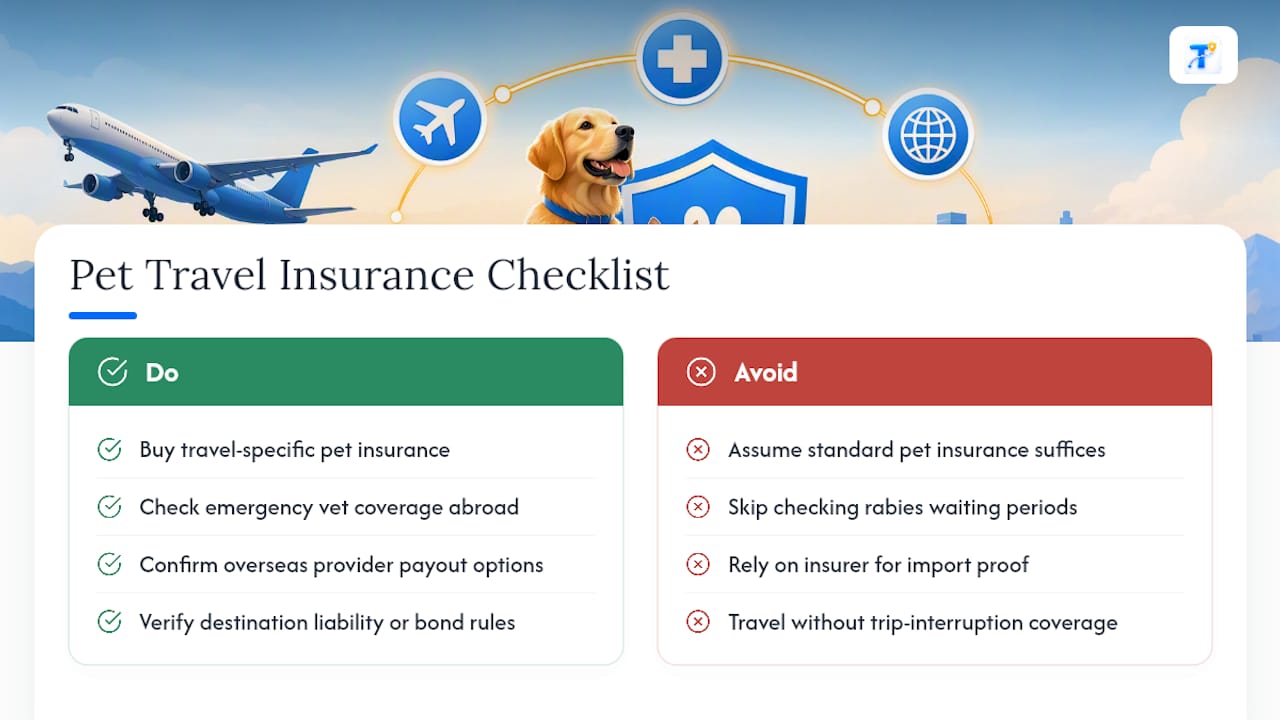
Standard pet health insurance rarely covers the specific risks of international travel, which is why a growing number of owners buy a separate travel-specific policy or add-on before crossing borders. Coverage worth checking for includes emergency veterinary care abroad, trip interruption if your pet is denied boarding over a paperwork issue, and liability coverage in case your pet injures someone or damages property in another country.
Airlines and countries don’t require pet travel insurance the way they require a health certificate, but a missed rabies waiting period or a rejected endorsement can strand you with unplanned boarding fees, emergency vet visits, or a delayed flight rebooking. A policy that reimburses those costs is worth the premium on any trip involving quarantine risk or a long layover.
If your pet will be boarded, quarantined, or hospitalized abroad, confirm in advance whether your policy covers overseas providers or only pays out after you submit receipts for reimbursement once home. Some destination countries, particularly ones with mandatory quarantine like parts of Australia, require proof of liability coverage or a bond as part of the import process itself, separate from any personal insurance you carry. Check the destination’s own import rules for that requirement rather than assuming your travel insurer’s standard policy satisfies it.
The Documentation Mistakes That Get Pets Turned Away
Most rejected pet paperwork traces back to a handful of repeat mistakes, and nearly all of them are avoidable with a few weeks of lead time.
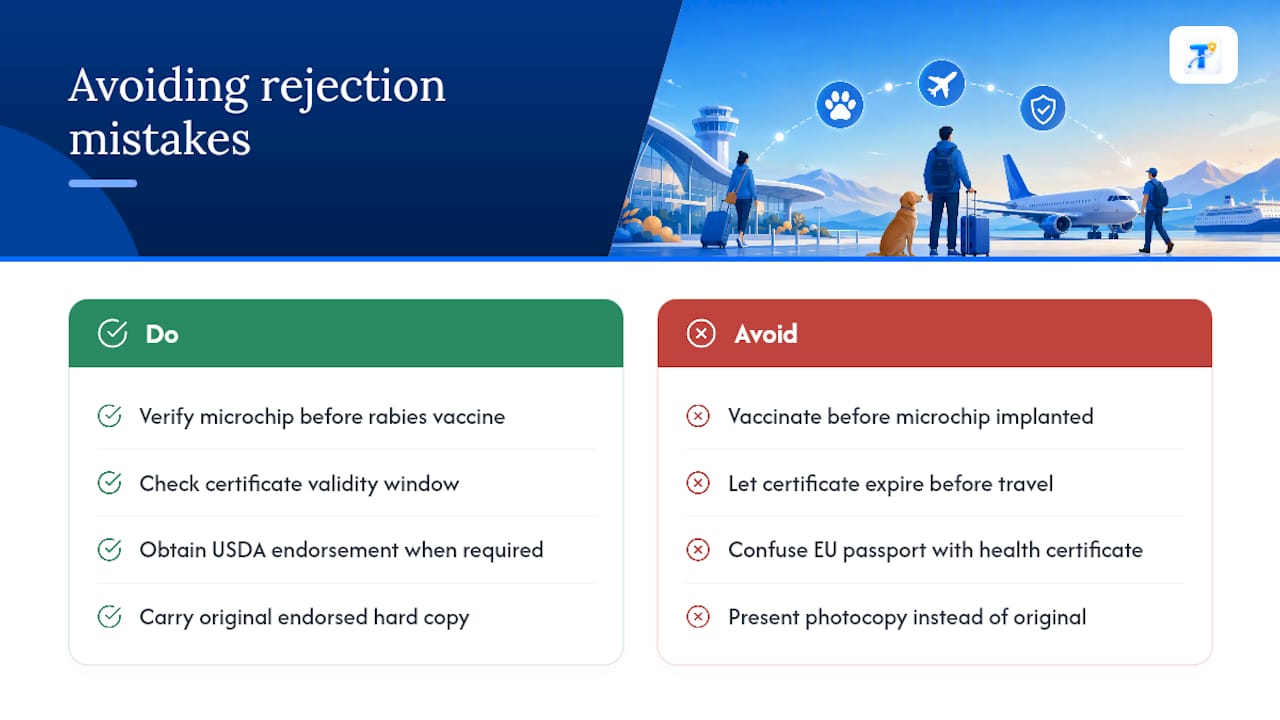
The most common error is vaccinating for rabies before the microchip is implanted, which many countries treat as if the vaccine was never given at all. A close second is letting the health certificate age past its validity window, since a certificate signed 12 days before a flight can be worthless if the destination enforces a strict 10-day rule. Owners also frequently confuse the EU pet passport with the animal health certificate, applying for the wrong document because a visiting pet needs the certificate, not the passport reserved for EU residents.
Missing USDA endorsement is another frequent snag: a complete, signed health certificate isn’t enough on its own if the destination requires the added government countersignature, and that step alone can add two weeks or more if submitted by mail rather than electronically through VEHCS. Travelers also sometimes present a photocopy or PDF at the border instead of the original endorsed hard copy, which officials commonly refuse outright.
If you discover an error close to departure, contact your USDA-accredited vet or the destination country’s embassy immediately. Some issues, like a certificate signed a day too early, can sometimes be resolved with an expedited re-exam; others, like a missed rabies waiting period, cannot be rushed at any price.
Pet Travel Rules in the UK, Canada, and Australia
Beyond the U.S. and EU, requirements shift enough from country to country that assuming one nation’s rules apply elsewhere is a common and costly mistake.
The United Kingdom requires an animal health certificate for pets arriving from outside the EU, along with proof of microchipping and rabies vaccination, and it enforces its own tapeworm treatment requirement for dogs entering from certain countries. Canada’s requirements depend heavily on the pet’s age and the exporting country: dogs from rabies-free or low-risk countries face lighter documentation than those from high-risk regions, and a valid rabies certificate is typically the core requirement rather than a titer test. Australia runs one of the strictest systems in the world, requiring an import permit applied for well in advance, a rabies titer test with a mandatory waiting period, and mandatory quarantine on arrival for most pets, regardless of vaccination history.
The pattern across all three: never assume a document that satisfies one country will satisfy another, even when the countries share similar rabies-risk classifications. Confirm each destination’s current rules directly with its government agency or embassy before you finalize a booking.
Where to Verify Requirements Before You Travel
Rules change, and the sources below are where updates appear first, well before a blog or forum catches up.
- USDA APHIS pet travel pages for export requirements and endorsement steps.
- CDC dog import pages for U.S. entry rules and high-risk country lists.
- European Commission guidance on EU 2026/705 for non-commercial pet movements.
- Your destination country’s embassy or consulate page for the final word on country-specific entry rules.
For general vaccine scheduling and pet health questions, a resource like the Animal Care of Hobe Sound blog offers practical veterinary guidance worth reading alongside the official government pages.
Sources
- Pet Travel | Domestic and International Travel With a Pet
- Travelling with a pet within the EU - Food Safety - European Commission
- Dog importation basics and CDC form
- Commission Implementing Regulation (EU) 2026/705
FAQ
What Documentation Do You Need to Fly With a Pet?
At minimum, expect to need a rabies vaccination certificate, an ISO microchip, and a health certificate signed by a licensed or accredited vet within your destination’s validity window. Airlines add their own forms on top, so confirm your carrier’s specific health-certificate age limit before booking.
How Do You Get Travel Documents for a Dog?
Start with a USDA-accredited veterinarian, who can implant or verify the microchip, administer or confirm the rabies vaccine, and issue the export health certificate. For destinations requiring endorsement, submit through VEHCS or by mail with enough lead time, generally at least two weeks.
What Are the Requirements for Traveling With a Pet to the USA?
Dogs entering or returning to the U.S. need a CDC Dog Import Form submitted online before arrival, with the confirmation receipt valid for six months. Dogs from CDC-designated high-risk rabies countries face additional screening and paperwork.
What Are the Requirements for Pets to Travel Internationally?
Most countries require an ISO-compliant microchip implanted before the rabies vaccine, a rabies certificate showing the correct waiting period, and a health certificate signed within a narrow window before entry, often 10 days under EU rules. Some destinations add import permits or rabies titer tests that require months of advance planning.
How Far Ahead Should You Start Gathering Pet Travel Documents?
Begin at least 8 to 12 weeks before departure, especially for international trips involving titer tests or USDA endorsement. Waiting periods for rabies vaccination and certificate validity windows are fixed and can’t be shortened once you’re close to your travel date.