

Is It Safe to Email Your Passport? Safer Ways to Send It
Emailing a passport scan carries real risk. Learn when it is reasonable, how to redact and protect a copy, safer ways to send it, and what to do if it leaks.

On this page

Emailing a photo or scan of your passport is not safe by default. Email is not built to protect sensitive documents: copies stay in several mailboxes, can be forwarded in one click, and you lose control over them once you hit send. Sometimes you have to send one anyway, for a tour operator, a visa agent or an employer’s travel desk. When you do, the risk drops sharply if you use the requester’s secure upload portal first, send only what the recipient needs, protect the file, and confirm the request is genuine.
This guide explains what can go wrong, what to do when you cannot avoid email, and how to keep your passport details organized without scattering copies across inboxes.
TL;DR
- A passport number, name and date of birth together are valuable to identity thieves, so treat a scan like a password you cannot change.
- Use a secure upload portal first. If email is the only option, send a redacted, password-protected or encrypted file and share the password through a different channel.
- Before sending anything, ask who needs it, why, and how long they will keep it. Do not respond to unexpected messages asking for passport details.
- Do not leave passport images sitting in your sent folder or inbox. Store a copy in one protected place and delete the rest.
- If a copy leaks, contact your bank, change passwords, check your credit reports and report the document to the issuing authority.
Table of Contents
- Why a passport scan deserves extra care
- What happens to a passport copy once you email it
- When emailing a passport copy is reasonable
- Safer ways to send a passport copy, in order of preference
- Redact and watermark before you send
- How to tell whether a request for your passport is legitimate
- Should you keep a passport copy on your phone or in your email?
- Keeping passport details organized without scattering copies
- How Tineo fits in
- If your passport information may have been exposed
- FAQ
- Sources
Why a passport scan deserves extra care
A passport page packs the key facts of your identity into one image. The Australian Passport Office notes that a passport contains your full name, date of birth, passport number and other details, and that exposing them can create a risk of identity fraud. The same page points out that controls such as facial recognition make it hard for someone else to use the physical document for travel. The bigger worry is the data, not the booklet.
The Identity Theft Resource Center explains that thieves combine personal identifiers with other information to impersonate victims, access existing accounts or create new government, financial, medical or social-media accounts. It also lists passports among commonly stolen identifiers and notes that passport information may help someone gain entry to a foreign location. The UK government’s Stop! Think Fraud campaign adds that stolen identity details may be used to open accounts, take over bank accounts or apply for credit that the fraudster never intends to repay.
None of this means a passport number alone empties your bank account. It means the number, the scan and a few other details such as your address or email can be pieced together. A scan is more useful to a criminal than a number, because it shows the layout, photo, signature and the machine-readable lines at the bottom.

What happens to a passport copy once you email it
When you send an attachment, you create at least three copies: one in your sent folder, one on your email provider’s servers and one in the recipient’s inbox and their provider’s servers. A guide from document-sharing company Granite says an emailed scan can remain in those places indefinitely and can be forwarded onward in one click.
The Australian Passport Office makes the same point in plainer terms: after you share identity information, you lose control over where it is stored, how it is managed and how long it is kept.
Three practical problems follow:
- Your own inbox becomes the weak point. If someone gets into your email account, every passport scan you ever sent or received is searchable by keyword.
- The recipient’s inbox is out of your hands. Their password habits, shared mailboxes and forwarding rules decide who else sees your file.
- Old messages never expire. A scan sent for a 2022 booking may still be sitting in a mailbox years later.
This is also why we treat booking details carefully in general. Our article on travel itinerary security explains why booking codes behave like passwords, and the same thinking applies to anything that identifies you.
When emailing a passport copy is reasonable
Some requests are normal. Airlines, cruise lines, tour operators and visa services often need passport details to complete a booking or an application. The question is not whether to ever share the information, but with whom, in what form and through which channel.
The DHS Handbook for Safeguarding Sensitive PII, written for the department’s own staff, lists passport numbers as sensitive personally identifiable information. Its guidance is useful as a benchmark even if you are not a federal employee. It says to redact, password-protect or encrypt such information in internal emails. For people outside the organization, it says to email it only in an encrypted or password-protected attachment, only to people with an official need to know, and to give the password separately.
Translate that to a traveler’s life and you get a short test. Email is acceptable when all of these are true:
- You contacted the business first, or you are completely sure the request belongs to a booking you made.
- A named person or team needs the document for a clear purpose.
- No secure upload option exists.
- The file is redacted where possible and protected with a password or encryption.
- The password travels through a different channel, such as a text message or phone call.
If any of those is missing, pause before sending.
Safer ways to send a passport copy, in order of preference
1. Use the requester’s secure upload portal
Granite recommends a secure portal supplied by the requesting organization over email, because the file goes directly into their system without leaving copies in intervening inboxes. Many airlines, visa processors and employers have one. Ask for it by name: “Do you have a secure upload link for travel documents?” A legitimate business will have heard that question before.
2. Use an encrypted transfer if no portal exists
If there is no portal, the same guide suggests an end-to-end encrypted transfer or an encrypted, password-protected attachment. Whichever you choose, send the password separately, share only with the person who genuinely needs the file, and redact fields the recipient does not need.
3. If it has to be a plain email attachment
Follow this sequence:
- Confirm the recipient’s address by looking it up on the company’s official website or calling a number you found yourself, not one in the message.
- Redact what is not required (see the next section).
- Add a watermark naming the recipient and purpose.
- Save the file as a password-protected or encrypted document.
- Send the email with the file and no hint of the password.
- Send the password by text or phone call.
- Ask the recipient to confirm receipt and tell you how long they will keep the file.
- Delete the file from your sent folder and downloads once the purpose is complete.
Avoid sending a passport scan over public Wi-Fi, and avoid sending it from a shared or work computer you do not control. Those are common-sense precautions rather than findings from a specific study, but they cost nothing.
Redact and watermark before you send
Anonymize My ID, a company that sells document-masking tools, recommends sending a redacted copy where possible: hide the passport number, the machine-readable zone, the date of birth and the signature and leave only what the recipient must match. It also suggests a watermark with the recipient, the purpose and the date, so a forwarded or leaked copy is visibly restricted and harder to reuse.
Here is how that might look in practice.
| Situation | What the recipient may truly need | What you can usually hide |
|---|---|---|
| A friend booking a shared rental needs to confirm your name spelling | Name as printed | Number, date of birth, machine-readable zone, signature |
| A host wants to verify you are the guest on the reservation | Photo and name | Number, machine-readable zone, signature |
| A visa or border-entry service | Often the full data page | Nothing, so use their portal instead of email |
Treat the table as an illustration, not a rule. Some organizations legally need the full page. Where that is the case, a portal matters even more, and you should ask what the legal requirement is rather than guessing.
A watermark can be as simple as a line across the image: “Copy for Hotel Example, reservation check, 3 Nov 2026.” Most phone photo editors let you add text. It will not stop a determined criminal, but it removes the easy reuse.
How to tell whether a request for your passport is legitimate
Scammers pose as travel companies, airlines and even passport offices. The Australian Passport Office’s advice applies anywhere: ask the organization what it intends to do with your passport information, and share it only with trusted organizations that legitimately need it. If a message may be fake, stop, do not click links or attachments, and do not respond. That page also says never to share passport photos online.
A quick checklist:
- You did not start it. An unexpected message asking you to “verify” your passport is a red flag.
- Urgency is the pressure. Threats such as a canceled flight or a lost reservation are common in phishing messages.
- The sender’s address looks slightly off. Check the domain, not only the display name.
- The link or attachment is the only route. Go to the airline or agency site by typing its address yourself.
- The request asks for more than the booking needs. Airline check-in rarely needs your mother’s maiden name or your bank details.
If you are unsure, contact the company using the phone number or chat on its official site and ask whether the message is genuine.
A related habit helps: keep one disposable email address for newsletters, fare-deal alerts and one-off sign-ups, so those mailings stay away from the inbox where your real booking confirmations and documents live. A disposable email address suits that low-stakes job. It is never the place to send or receive anything sensitive.
Should you keep a passport copy on your phone or in your email?
People disagree here, and the honest answer is that a copy is useful when you lose a passport abroad, but a copy left in the wrong place becomes a risk. Canada’s Global Affairs travel guidance advises never sharing travel-document information unless necessary and keeping documents secure. It also says that if your passport is lost or stolen abroad, you should contact the nearest Government of Canada office, and that reporting it lost means it can no longer be used for travel.
A common tip is to email yourself a photo of your passport. It works as a backup, but it puts an unprotected image in an inbox that is searchable and often synced to several devices. Consider this approach instead:
- Keep one protected copy, not many. Choose one place with a strong password and two-step sign-in, ideally one that also works without a signal.
- Do not leave images in your camera roll. Photos often sync to cloud albums, shared family albums and messaging backups.
- Keep a paper photocopy separate from your passport. A paper copy stays useful when a phone is lost or the battery dies, and it cannot be hacked.
- Remember what a copy is for. It helps officials and embassies replace a lost document faster. It is not a substitute for the passport at the border.
- Delete old copies after the trip, especially from sent folders and chat threads.
Our guides on making secure travel document copies before departure and storing passport copies safely walk through this routine in more detail. If you are building a full system, the travel document organizer guide covers the rest of the file set.
On the physical side, Australia’s Smartraveller advises keeping your passport in a safe place and always knowing where it is. The same logic applies at home: a passport in a hotel safe or a zipped inner pocket is much less exposed than one in a back pocket or a beach bag.
Keeping passport details organized without scattering copies
The reason passport scans end up in so many inboxes is simple: travel information is spread everywhere. Flight confirmations sit in one email thread, the hotel in another, the car rental in a third, and a family member asks for “that passport photo” in a group chat. Each request creates another copy.
A better habit is to keep trip information in one place and share it deliberately. For booking details, that means pulling confirmations into a single itinerary. Our guide to organizing travel confirmation emails shows how, and our post on boarding pass screenshots covers a document people often store carelessly.
How Tineo fits in
Tineo is a travel planning and itinerary app that turns booking confirmation emails into an organized trip. Flights, lodging, car rentals, activities and documents live in one timeline across web, iOS and Android, and you can share the trip with friends or family instead of forwarding emails around. Tineo does not book travel. It organizes what you have already booked.
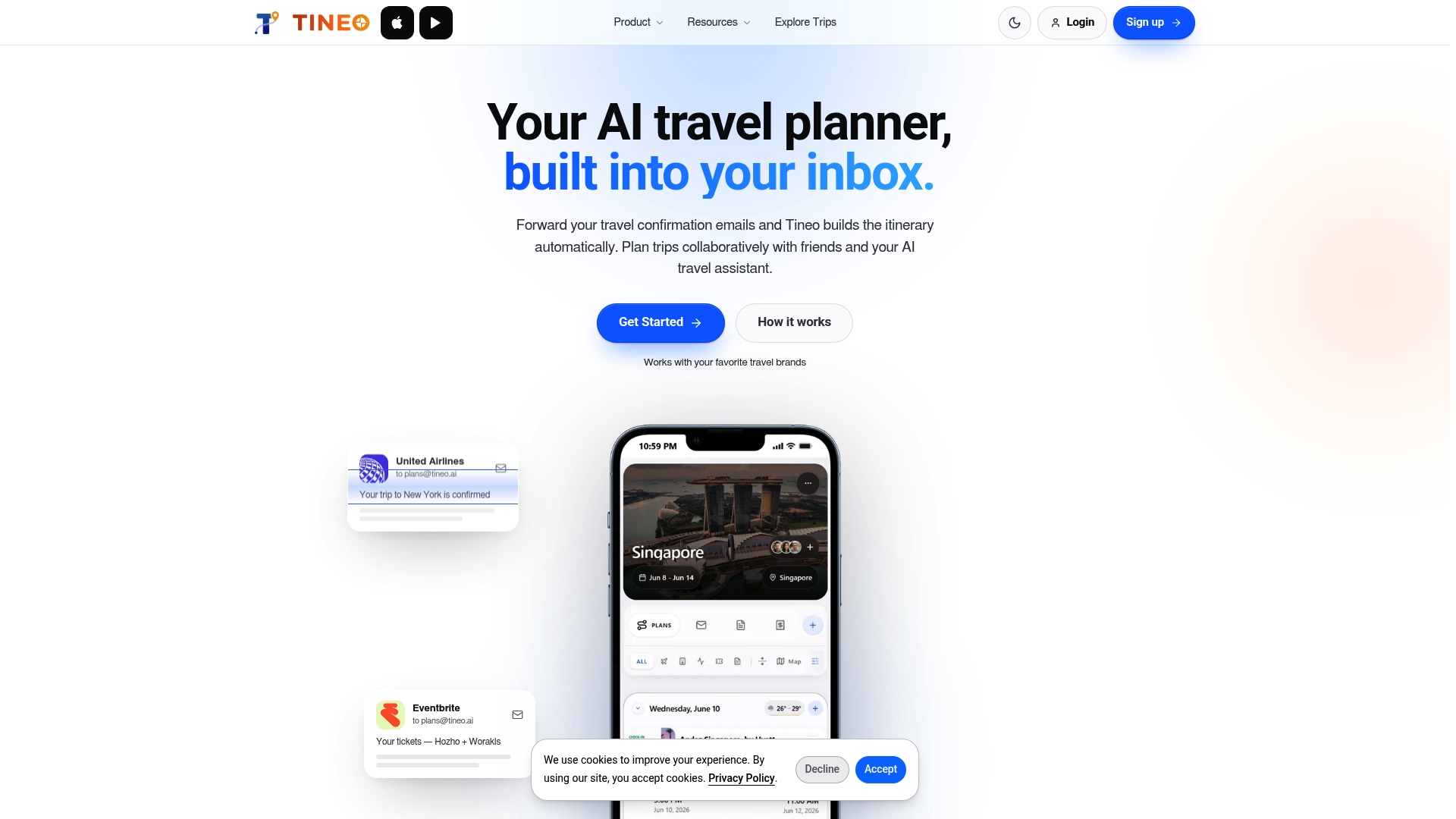
The core plan is free at $0 per month. Tineo Ultra costs $4.99 per month or $39.99 per year and adds capabilities such as offline access, document intelligence and advanced AI features. See the current plan details on the Tineo pricing page, or look at the Tineo app if you want one place for your trip details. For passports specifically, the practical benefit is fewer scattered copies: you keep documents with the trip they belong to, rather than in a chain of old messages.
If your passport information may have been exposed
Act quickly, and work through the steps in order of urgency. The Stop! Think Fraud guidance recommends that you contact your bank about unusual or pending transactions, change passwords and PINs, check your credit reports, and report lost or stolen documents to the issuing organization and the police.
A practical order:
- Secure your email first. Change the password and turn on two-step sign-in, since email is where password resets arrive.
- Call your bank and card issuers if you see anything unfamiliar.
- Check your credit reports for accounts you did not open.
- Report the document if the physical passport is missing. Reporting it lost means it can no longer be used for travel, per Canada’s travel guidance linked above.
- Contact the issuing authority. In the US that is the State Department, and your local police can provide a report if you need one.
- Consider extra protection. In the UK, Cifas Protective Registration costs £25 for two years and prompts participating organizations to run extra checks when your details are used. US readers should check their credit bureaus’ official pages for freeze and alert options.
If you are a victim in Australia, Smartraveller points to IDCARE for support.
FAQ
Is it okay to share a photo of my passport?
Only when someone with a genuine need asks for it, and ideally through a secure upload portal. The Australian Passport Office advises against sharing passport photos online and says to disclose passport information only to trusted organizations that legitimately need it. If a friend or host just needs your name spelled correctly, type it instead of sending an image.
Is it safe to email a passport copy to a travel agent?
It is safer when you have confirmed the agent is real, asked for a secure upload link and, failing that, sent a redacted file protected by a password. Send the password by text or phone, not in the same email. Ask how long they will keep the copy.
Should I email myself a copy of my passport?
A backup is useful, but an unprotected image in your inbox is easy to find if the account is ever compromised. Store one copy in a protected, password-secured location and keep a paper photocopy separate from your passport. Delete extra copies from sent folders and chat apps after your trip.
What can someone do with my passport number?
On its own, usually not much, but combined with other personal details it can help someone impersonate you or open accounts, according to the Identity Theft Resource Center. A scan gives them more to work with than a number does. Treat both as sensitive and share them only with people who need them.
What should I do if I think my passport details leaked?
Secure your email, call your bank, change passwords and PINs, and review your credit reports. If the physical passport is missing, report it lost or stolen to the issuing authority and the police. Keep a record of what you sent, to whom and when.
Sources
- DHS Handbook for Safeguarding Sensitive PII
- Data breaches and scams, Australian Passport Office
- How to send documents securely, Granite
- How to send a copy of your passport safely, Anonymize My ID
- What Can Someone Do With Your Personal Identifiers?, Identity Theft Resource Center
- What to do if your identity has been stolen, Stop! Think Fraud
- Passport services, Smartraveller
- Bon voyage, but… Essential information for Canadians, Government of Canada