

Best Travel Safety Apps: What Each One Does and How to Pair Them
Compare the best travel safety apps: Noonlight, bSafe, GeoSure, I'm Alive, SafePing and more. See what each does, what it costs and how to combine them.

On this page

No single app covers every travel safety need. The strongest setup combines an active emergency app such as Noonlight or bSafe, a passive check-in tool such as I’m Alive or SafePing, destination intelligence such as GeoSure, and one organized place for your bookings and emergency details, which is where we fit in with Tineo. Below we compare each option by what it does, what it costs and where it falls short, so you can build a small kit instead of installing ten apps.
TL;DR
- Active SOS: Noonlight and bSafe let you trigger an alert fast. Noonlight routes it to a monitored dispatch center, while bSafe alerts your chosen Guardians.
- Passive check-ins: I’m Alive and SafePing notify your contacts if you miss a check-in, which helps when you cannot reach your phone.
- Destination research: GeoSure scores countries, cities and neighborhoods before you book or walk anywhere new.
- Organization: Tineo keeps confirmations, documents and emergency contacts in one shared itinerary, so the people who need your plans can find them.
- Limits: Most of these apps need a data connection and none replaces knowing the local emergency number.
Table of Contents
- How we compared these apps
- Quick comparison table
- Active SOS apps: Noonlight and bSafe
- Passive check-in apps: I’m Alive and SafePing
- Destination intelligence: GeoSure
- Official and situational tools
- Where safety apps fall short
- The layer most safety lists skip: your itinerary
- Build a kit by traveler type
- Set up your kit before you leave
- Where Tineo fits
- FAQ
- Sources
How we compared these apps
We looked at four things a traveler actually cares about: how the app raises an alarm, who receives it, what it costs, and what happens when your signal or battery fails. We did not run first-hand tests, so everything below comes from each provider’s own pages or the published sources we link. Prices change, so confirm the current figure in the app store before you subscribe.
We also separated apps by job. Comparing a panic button with a safety-score database is like comparing a seatbelt with a road map. Both help, but you need to know which problem each solves.
Quick comparison table
| App | Best for | How it alerts | Price noted in our sources |
|---|---|---|---|
| Noonlight | Active SOS with live dispatch | Dispatchers text and call you, then contact 911 if there is no response | Free core tier; premium reported from about $9.99 per month |
| bSafe | Alerts to friends and family | Guardians get your real-time location | Premium reported at $4.99 per month or $49.99 per year |
| I’m Alive | Trip timers and check-ins | Contacts are alerted if you miss a check-in | Reported at $4.99 one time for limited use, or $39.99 per year unlimited |
| SafePing | Passive check-ins | SMS to contacts after 12 to 72 hours without a check-in | See the app’s own page |
| GeoSure | Neighborhood safety research | Scores and insights, not alerts | Access and Plus listed at $4.99 per month |
| AllTrails | Hikers | Lifeline shares location and estimated return time | AllTrails+ listed at $35.99 per year |
| Red Cross Emergency | Disasters and weather | Official alerts and shelter locations | Free |
| Tineo | Organized bookings and shared plans | Shared itinerary and emergency contacts | Free tier; Ultra $4.99 per month or $39.99 per year |
Active SOS apps: Noonlight and bSafe
An active SOS app is for the moment you feel unsafe and can still use your phone. You press a button or say a command, and someone is told.
Noonlight
Noonlight describes itself as an emergency response service that connects first responders with device data and offers 24/7 protection with remote dispatching through authorized agents. In practice, a review of the app says dispatchers text and call you, then contact 911 if you do not respond. That monitored step is the main reason people pick it.
The catch for international travelers is coverage. One comparison reports that the panic button is primarily functional within the United States, with a free core tier and premium plans starting at roughly $9.99 per month. If you are heading abroad, check Noonlight’s current supported countries before you rely on it. Noonlight’s own site lists the US, Canada, Australia, New Zealand, Ireland and the UK among its markets.
bSafe
bSafe puts your circle of trusted contacts, called Guardians, at the center. Its own site says the SOS button starts audio and video recording automatically, including by voice command, and that live streaming lets guardians see and hear what is happening. Guardians receive your real-time location when you trigger an alert.
A review lists premium voice-activated SOS and live streaming at $4.99 monthly or $49.99 annually. The same review suggests testing the SOS with a Guardian before you depend on it, which is good advice for any alert tool. Do it at home, not at the airport.
Which one should you pick?
Choose Noonlight if you want a professional dispatcher in the loop and you travel mainly in supported countries. Choose bSafe if your priority is that specific people, such as a partner or parent, see your location and hear what is happening. Many travelers install one and set up the other only if their route changes.
Passive check-in apps: I’m Alive and SafePing
Active apps fail when you cannot reach your phone. Passive apps cover that gap by acting when you do not do something.
I’m Alive offers a trip timer that alerts contacts if you miss a check-in. A 2026 comparison reports a one-time $4.99 fee for limited usage or $39.99 per year for unlimited trips. It suits a day trip into remote country or a solo bus ride at night.
SafePing works on a longer horizon. According to its FAQ, it alerts your contacts by SMS if you fail to check in after a threshold you set, between 12 and 72 hours. The same page explains why it leans on your contacts instead of calling local emergency services automatically: language barriers, jurisdiction questions and potential false-alarm fees can make automatic calls in a foreign country problematic. That is a thoughtful design choice for multi-day travel, because a person who knows you can judge a missed check-in better than a dispatcher abroad.
Whichever you choose, tell your contacts what to expect. A message that says “Sam has not checked in” is only useful if the recipient knows which city you are in and which hotel you booked. That is a job for your itinerary, which we cover below.

Destination intelligence: GeoSure
GeoSure does something different: it helps you decide where to stay and how to move around. Its App Store listing says it provides AI-enhanced safety scores for countries, regions, cities and neighborhoods, with an overall score and seven more categories. The same listing puts GeoSure Access and Plus at $4.99 per month.
The company’s own site describes data on 71 million points of interest across 200+ countries, covering physical safety, theft, women’s safety, LGBTQ+ safety, health, nighttime safety and political freedoms. The category split is the useful part. A neighborhood can score well on theft and poorly on nighttime safety, and the right choice depends on when you plan to be out.
Use GeoSure before you book a hotel or choose a late-night route, not in the middle of an emergency. Then keep the result with your plans so your group sees the same information.
Official and situational tools
Two free tools belong in almost every kit, and neither is a startup product.
STEP from the U.S. State Department. If you travel outside the United States, the State Department asks you to enroll in its Smart Traveler Enrollment Program. It is free, sends email alerts from U.S. embassies and consulates, and helps the embassy contact you or your emergency contact in a crisis. It is the right place to check changing requirements and advisories for your destination. Readers outside the US should look for their own government’s equivalent.
American Red Cross Emergency app. The Red Cross says the free app offers preparation tips, National Weather Service alerts, live weather maps and open shelter locations, in English and Spanish. Its First Aid app is also free, with step-by-step advice and hospital locating. Both are most useful for US trips, hurricane season travel and road trips.
AllTrails. For hikers, the Lifeline feature shares your location and estimated return time with contacts, and offline maps help when coverage drops. One roundup lists AllTrails+ at $35.99 per year.
Where safety apps fall short
Here is the practical limit: most of these apps need an active cellular or data connection, and they do not replace knowing the local emergency numbers at your destination. Write down the number for each country before you land, since it is not always 911.
Battery and privacy matter too. A travel-tech guide warns that no single app is enough and that you must account for battery life, connectivity gaps and privacy concerns from persistent tracking. Its more pointed advice is that a 10,000mAh power bank may be a more important safety purchase than any app. We agree that a dead phone cancels every app on this list.
When you will be out of coverage altogether, hardware is the alternative. HMD’s OffGrid device provides satellite SOS, messaging, check-ins and location sharing on a dedicated plan. For tracking bags, vehicles or gear without a phone plan, a GPS tracker that works without a SIM card can complement an active SOS app, though it does not call for help on its own.
Before you commit to a tracking app, review its location settings. Share your location only with people you chose, and switch off sharing after the trip.

The layer most safety lists skip: your itinerary
When something goes wrong, the first questions are mundane. Where is the hotel? Which flight? What is the confirmation code? Who is the emergency contact? An SOS app can tell people where your phone is, but it cannot tell them where you were supposed to be.
That is why one smarter-travel guide describes a safety stack that includes a secure document and itinerary vault alongside location sharing, an SOS app and a VPN. We built Tineo for that last piece. It turns booking confirmation emails into an organized trip, with flights, lodging, car rentals and activities on a single timeline, available on web, iOS and Android.
Here is how we suggest using it as part of a safety setup:
- Forward your confirmations. Bring flights, hotels and rentals into one trip so no one has to search your inbox.
- Add emergency contacts. Our guide to setting up emergency contacts in your trip app takes about five minutes.
- Store your documents. Copies of your passport and insurance should live where you can reach them. See why to make copies 48 to 72 hours before departure, and how to store trip files in a document organizer app.
- Share the plan. A family member or travel partner can see where you should be. You can also share flight details by text, maps or a trip link.
- Protect the details. Booking codes can work like passwords, so read why travel itinerary security deserves attention before you post a screenshot.
A shared itinerary also supports your check-in apps. If SafePing texts your sister after 48 hours of silence, she can open the trip and see your hotel, your flight back and the car rental company, instead of guessing.
Build a kit by traveler type
There is no universal answer, so match the kit to the trip.
| Traveler | Suggested combination |
|---|---|
| Solo traveler in cities | GeoSure for research, bSafe or Noonlight for SOS, a shared Tineo itinerary |
| Solo hiker | AllTrails Lifeline or I’m Alive timer, offline maps, a power bank |
| Family vacation | Location sharing your family already uses, the Red Cross Emergency app, a shared itinerary with everyone’s documents |
| Group trip | One shared trip everyone can open, STEP enrollment for each international traveler, agreed check-in times |
| Business traveler | STEP, a shared itinerary with your assistant or team, SOS app for late arrivals |
| Remote or multi-day backcountry | Satellite device, SafePing with a long threshold, a detailed plan left with contacts |
For family and group trips, one more option is Life360. Its release for UK members describes family location sharing and crash detection. That announcement dates from October 2023 and lists UK prices, so check the current US plans before you buy.
Set up your kit before you leave
A short routine beats a long app list.
- Pick one active and one passive tool. More than that creates alert fatigue for your contacts.
- Test everything at home. Trigger a test alert with a trusted person, as the bSafe review advises.
- Brief your contacts. Tell them what a message from each app looks like and what to do next.
- Enroll in STEP if you are leaving the United States.
- Save local emergency numbers for every country on your route, and keep them offline.
- Organize your bookings in one shared trip, with documents and emergency contacts attached.
- Charge and carry backup power. Download offline maps for areas with weak coverage.
Where Tineo fits
We are not a panic button, and we do not book travel. Tineo is the place your trip details live, so the people helping you can find them. The free plan covers the core of organizing a trip, and Tineo Ultra, at $4.99 per month or $39.99 per year, adds advanced AI capabilities, offline access and document intelligence. Offline access is useful when your connection is not. You can compare plans on our pricing page.
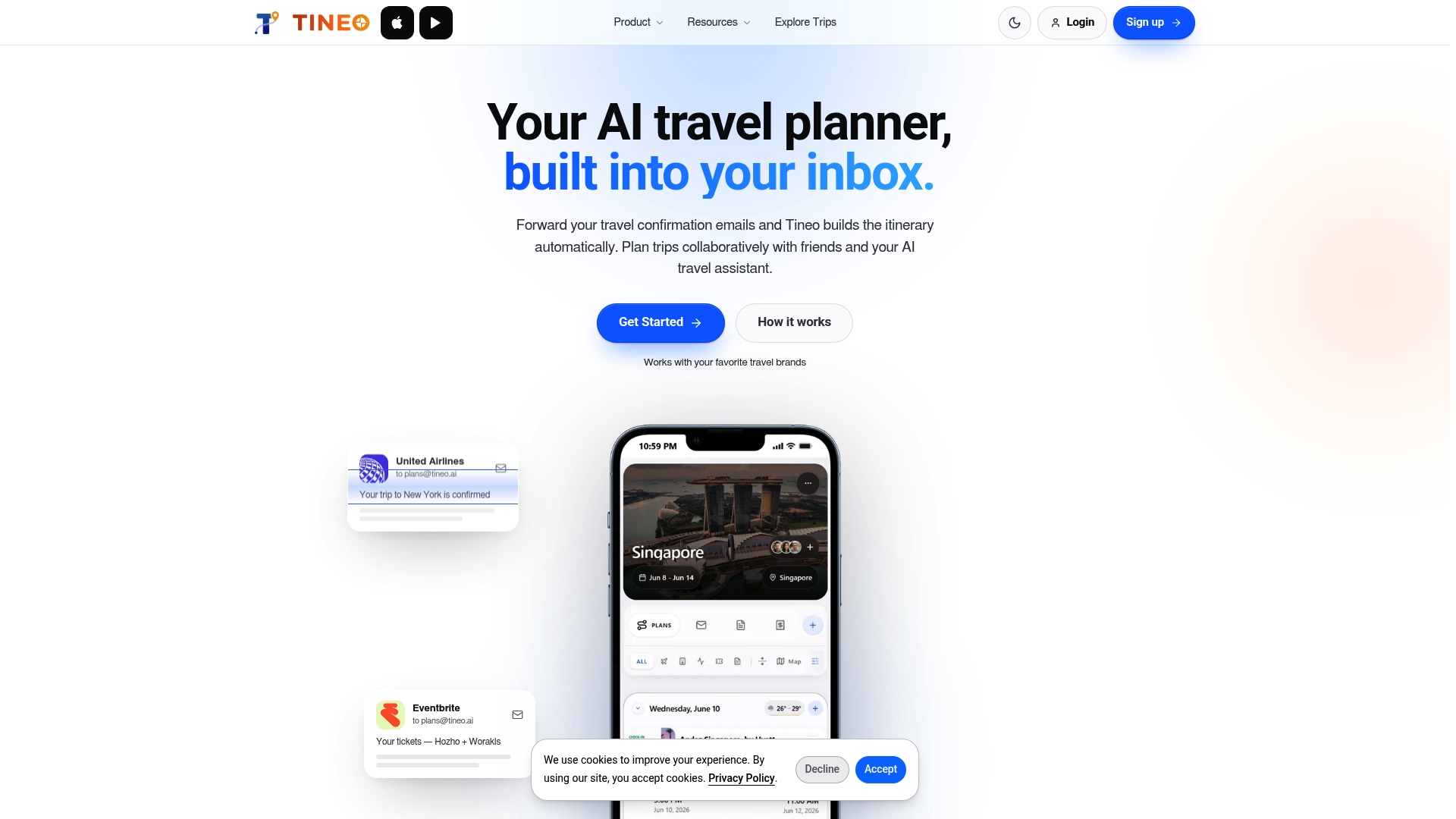
If you want your itinerary, documents and emergency contacts together before your next trip, you can try Tineo and forward your first confirmation email.
And if you used TripCase and are looking for a replacement, our guide to building a trip history tracker with one email walks through the move.
FAQ
What is the best travel safety app overall?
There is no single best app, because the apps do different jobs. Noonlight and bSafe handle active alerts, I’m Alive and SafePing handle missed check-ins, and GeoSure helps you research a destination. Most travelers do best with one active tool, one passive tool and an organized itinerary.
Do travel safety apps work without internet?
Mostly no. Most need a cellular or data connection, and they do not replace knowing local emergency numbers. For areas without coverage, consider a satellite device such as HMD OffGrid, download offline maps, and leave a detailed plan with your contacts.
Are travel safety apps free?
Many offer a free basic tier, with paid plans for advanced features. The figures we found run from about $4.99 per month for bSafe premium and GeoSure to about $9.99 per month for Noonlight’s premium tier. Confirm current prices in the app store, since plans change.
Should I enroll in STEP if I am a US citizen traveling abroad?
The State Department says travelers outside the United States should enroll. The service is free, sends alerts from U.S. embassies and consulates by email, and helps the embassy contact you or your emergency contact in an emergency.
Sources
- Noonlight: Smart Emergency Response & Monitoring
- bSafe | Emergency Alert and Response System
- bSafe App Review: SOS Alerts & Live Tracking
- Best Solo Travel Safety Apps 2026: 13 Compared | ImAlive
- SafePing FAQ
- GeoSure App on the App Store
- GeoSure AI Safety Intelligence Engine
- Smart Traveler Enrollment Program, U.S. Department of State
- American Red Cross Mobile Apps
- 12 Best Personal Safety Apps in 2026 Compared
- I’m Alive vs bSafe vs Noonlight (2026)
- What are the best solo travel safety apps in 2026
- HMD OffGrid
- Life360 UK launch announcement