

Best Itinerary App for iPhone: 6 Options Compared
Compare the best itinerary apps for iPhone: Tineo, TripIt, Wanderlog, Flighty, Google Maps and Notion. See how each organizes bookings and group trips.

On this page

The best itinerary app for iPhone is the one that gets your bookings into a single timeline with the least typing. For trips you have already booked, we recommend Tineo, which turns confirmation emails into an organized trip you can open on iPhone, Android and the web. TripIt is the best-known alternative for email-based organizing. Wanderlog, Flighty, Google Maps and Notion each cover a different job. Below, we compare them by what you need most: adding bookings, group planning, iPhone-friendly features and cost.
TL;DR
- If your flights, hotels and rentals are already booked, pick an app that reads confirmation emails so you don’t retype anything. Tineo and TripIt both work this way.
- Tineo is our pick for booked trips and group coordination. The core tier is free, and Ultra costs $4.99 per month or $39.99 per year.
- Wanderlog suits building a day-by-day plan on a map. Flighty suits flight tracking. Google Maps and Notion suit people who like building their own system.
- Prices and free-tier limits change often, so confirm them on each app’s App Store page before you subscribe.
- Coming from the retired TripCase? Treat it as a migration: gather your confirmation emails and import them into a current app.
Table of Contents
- What to look for in an iPhone itinerary app
- The six options at a glance
- Tineo: best for turning booked trips into one itinerary
- TripIt: the established email-forwarding organizer
- Wanderlog: best for planning places on a map
- Flighty: best for flights
- Google Maps and Google Sheets: free and flexible
- Notion: a custom trip dashboard
- How the apps compare on what matters
- Which app should you choose?
- How to set up your itinerary on iPhone
- Moving from TripCase
- Try Tineo for your next trip
- FAQ
- Sources
What to look for in an iPhone itinerary app
Most people searching for an itinerary app have the same problem. Their trip lives in a dozen places: an airline email, a hotel confirmation, a car rental PDF, a screenshot of a tour ticket. Before you compare apps, decide which of these jobs matters most to you.
- Getting bookings in. Does the app read your confirmation emails, or do you type each reservation by hand? Manual entry is fine for two flights. It becomes a chore for a ten-day trip with six hotels.
- Seeing the whole trip in order. A good itinerary shows one timeline: flight, transfer, check-in, dinner, tour, checkout. You should not need to jump between five emails.
- Sharing with other people. If you travel with family or friends, others need to see the plan without asking you for screenshots.
- Working on the road. Maps, alerts and offline access matter most when your signal is weak or you are abroad.
- Cost. Many apps have a free tier and a paid tier. The difference is usually alerts, offline access or advanced features, so check which of these you will actually use.
The rest of this guide uses those five criteria.
The six options at a glance
| App | Best for | How bookings get in | Group sharing | Cost |
|---|---|---|---|---|
| Tineo | Booked trips, families and groups | Confirmation emails become a trip timeline | Yes, share and collaborate | Free tier; Ultra $4.99/month or $39.99/year |
| TripIt | Email-based organizing, flight alerts | Forward reservation emails to your account | Yes | Free and paid plans; check the App Store for current pricing |
| Wanderlog | Building a day-by-day plan on a map | Mostly planned inside the app | Yes | Free and paid plans; check the App Store for current pricing |
| Flighty | Flight tracking and delay alerts | Flight-focused | Limited to flights | Check the App Store |
| Google Maps + Sheets | Free, do-it-yourself planning | Manual | Yes, through shared files | Free |
| Notion | Custom trip dashboards | Manual | Yes | Free and paid plans |
We describe competitors in general terms here because their features and prices change. Each one’s official App Store listing has the current details.
Tineo: best for turning booked trips into one itinerary
Tineo is our app, so we will tell you what it does and leave the judging to you. Its core idea is simple: you already have the confirmations, so the app should do the organizing.
Tineo takes the booking confirmation emails you receive and turns them into an organized trip. Flights, lodging, car rentals, activities and other reservations go into one timeline. You can open that trip on the web, on iOS and on Android, which helps when one person in your group uses an iPhone and another does not.
What it covers:
- Automatic import. Confirmation emails are parsed into itinerary entries, so you spend less time on manual data entry.
- One timeline. Flights, hotels, car rentals, activities and documents sit together in a single trip view.
- Collaboration. You can share a trip and plan with friends or family, so everyone sees the same details.
- Document storage and offline access. Keep trip documents with the trip. Offline access and document intelligence are part of the paid Ultra plan.
- AI travel assistant. Ask questions in the context of your own trip, rather than starting from a blank chat.
Cost: Tineo Free is $0 per month. Tineo Ultra is $4.99 per month or $39.99 per year, and it unlocks advanced AI capabilities, offline access, document intelligence and premium trip management tools. See the Tineo pricing page for the current plan details.
Good fit if: you book through many different sites, you travel with a group, or you want a shared itinerary without building one by hand.
What it is not: Tineo organizes the trip you have booked. It does not book travel for you and does not promise any outcome for your trip.
If your reservations arrive in Gmail, our guide to a Gmail travel organizer walks through how confirmations become trip entries.
TripIt: the established email-forwarding organizer
TripIt is the app most people name first, and for good reason. Rick Steves describes it as a free itinerary organizer where you forward reservation emails to your account and it adds them to your itinerary automatically, with real-time flight change alerts.
Strengths:
- A long track record with frequent travelers.
- A forwarding workflow that is easy to understand: send the email, get the entry.
- Flight alerts that help when plans change.
Tradeoffs to weigh:
- Alerts and some extra features sit in a paid tier, so decide whether you need them before choosing.
- It is built around the individual traveler’s account, so think about how you will share with a group.
If you are deciding between TripIt and a newer tool, we compared a similar pair in TripIt vs Trippsy. The same criteria apply here: how bookings come in, how sharing works and what the paid plan adds.
Wanderlog: best for planning places on a map
Wanderlog is a planning-first app. It is popular for building a day-by-day plan, saving places and seeing them on a map. That makes it a good match for the early stage of a trip, when you are deciding what to do in each city.
Strengths:
- Map-based planning for sightseeing, restaurants and routes.
- Collaborative planning, so friends can add ideas.
Tradeoffs to weigh:
- It is strongest at the dreaming and planning stage. After you book, you may still want a place where confirmations are collected for you.
- Free and paid tiers differ. Many readers ask whether Wanderlog is actually free, and the honest answer is that there is a free tier and a paid one. Look at the current App Store listing to see exactly which features sit behind the paid plan.
Many travelers use a planning app for ideas and a booking organizer for confirmations. That pairing works well, because the two jobs are different.
Flighty: best for flights
Flighty is not a full itinerary manager. It tracks flights and sends delay alerts, and it appears among the essential travel apps in the App Store. If flying is the riskiest part of your trip, a flight tracker is a useful companion to an itinerary app.
We covered how alerts fit into trip planning in flight status alerts. The short version: keep your itinerary as the source of truth, and use alerts to catch changes early.
Google Maps and Google Sheets: free and flexible
Google Maps paired with Google Sheets remains a common do-it-yourself setup. You save places in Maps, then list flights, hotel addresses and confirmation numbers in a spreadsheet you can share.
Strengths:
- Free and familiar.
- Fully customizable.
- Easy to share through a link.
Tradeoffs to weigh:
- Every entry is manual. You copy details from each confirmation yourself.
- Nothing updates itself. If a reservation changes, you edit the sheet.
This setup works well for short trips and for people who enjoy building their own system.
Notion: a custom trip dashboard
Notion lets you build a trip page with tables, checklists and notes. Some travelers love it for trips with a lot of moving parts. Like the spreadsheet approach, it relies on you to enter and maintain the data. It is a flexible workspace rather than a travel-specific tool.
How the apps compare on what matters
Adding bookings
Tineo and TripIt both start from your confirmation emails. That is the biggest time saver if you book across airlines, hotel sites and rental companies. Wanderlog, Google Sheets and Notion start from what you type or save.
Group trips
Group travel is where itineraries usually fall apart. One person holds the hotel confirmation, another has the rental car, and everyone asks the same questions in the group chat. A shared itinerary solves this. Tineo is built for sharing and collaborating, and Wanderlog also supports group planning. With Sheets and Notion, sharing works, but you maintain the content.
iPhone features
On iPhone, the features that matter most are quick access from the home screen, alerts and offline access. In Tineo, offline access is part of the Ultra plan. For any app you choose, test the offline experience before you leave, for example by switching your phone to airplane mode and opening the trip.
Price
Every app here has a free route. The paid tiers differ in what they add, so decide based on features you will use. For Tineo, the numbers are $0 for Free, $4.99 per month for Ultra, or $39.99 per year. At the annual price, Ultra works out to less than the monthly price times twelve, which would be $59.88.

Which app should you choose?
Use this quick guide.
- You have booked flights, hotels and cars across several sites: choose an app that reads confirmation emails. Tineo or TripIt.
- You are traveling with family or friends: choose a shared itinerary. Tineo is a strong fit.
- You are still deciding what to do each day: start in Wanderlog or Google Maps, then bring your bookings into your itinerary app.
- You fly often and worry about delays: add Flighty or use alerts in your itinerary app.
- You like building your own system: Google Sheets or Notion.
You do not have to pick only one. A common combination is a planning app for ideas and an email-based organizer for everything you have paid for.
How to set up your itinerary on iPhone
Here is a simple routine that works with any email-based organizer.
- Gather your confirmations. Search your inbox for your airline, hotel and rental company names. Include activity tickets.
- Import or forward them. Connect your email or forward each confirmation to the app.
- Check the timeline. Scan each day for gaps, like a hotel checkout with no onward transport.
- Share it. Invite your travel companions so they see the same plan.
- Prepare for offline. Save key documents and confirm you can open the trip without a signal.
- Check official requirements. Entry rules and documents change. Use the official government site of your destination for the current rules, not an app.
For a deeper walkthrough of keeping emails tidy, see our guide on how to organize travel confirmation emails.
Moving from TripCase
TripCase has been retired, so if you used it, your trips need a new home. The practical approach is to treat this as a migration.
- Find the original confirmation emails for upcoming trips in your inbox.
- Choose a new app from the list above.
- Import or forward those confirmations.
- Check each entry against the original confirmation, especially times and confirmation numbers.
Because email-based apps rebuild the itinerary from the confirmations themselves, you do not need an export file from the old app.
Try Tineo for your next trip
If you want your confirmation emails organized without retyping them, Tineo is designed for that job. Start on the free tier, add a trip, and share it with the people you are traveling with. Ultra adds advanced AI, offline access and document intelligence when you want them.
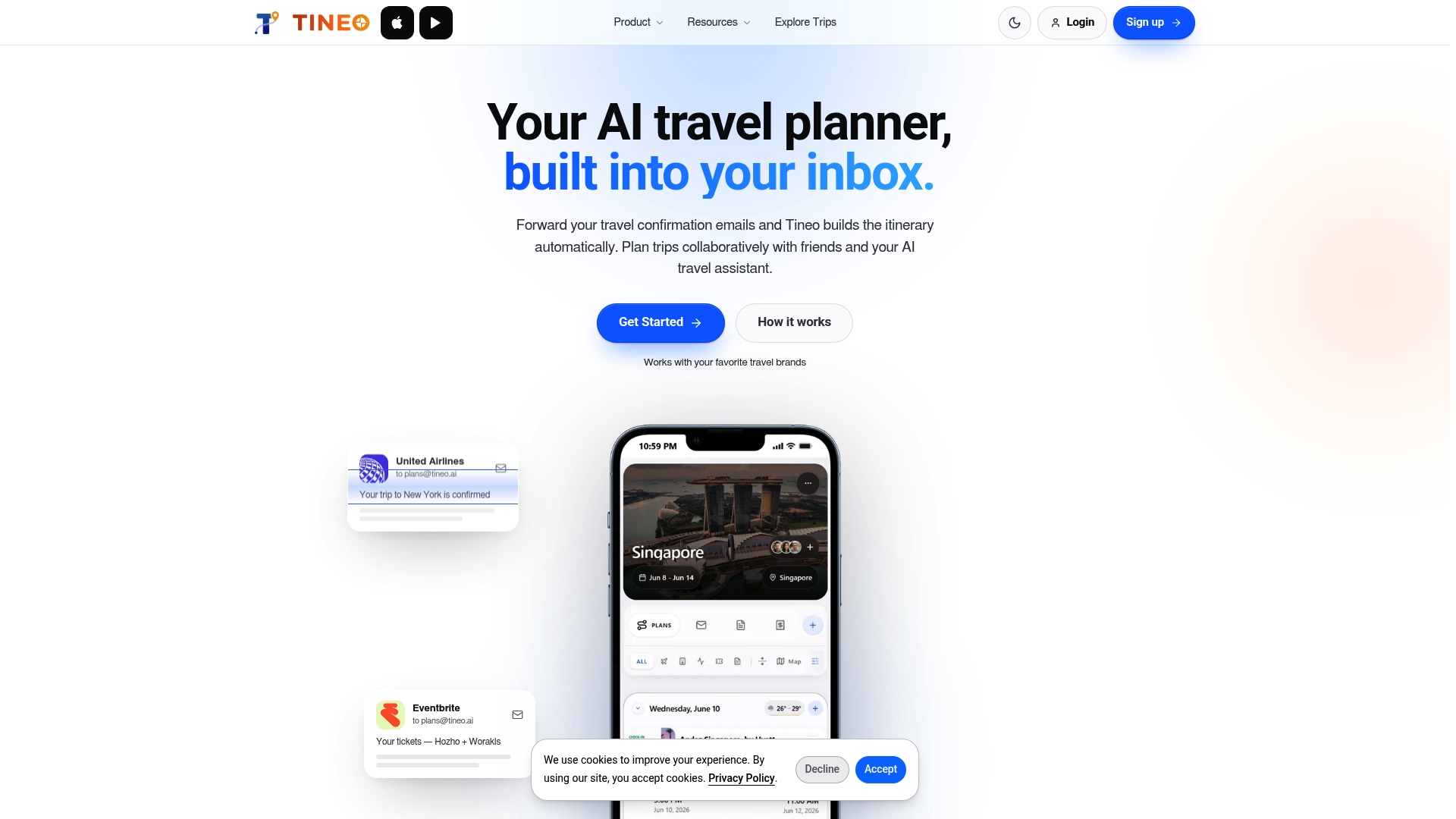
You can see plans on the Tineo pricing page, read recent updates on what’s new, or visit Tineo to get started.
FAQ
What is the best itinerary app for iPhone?
It depends on the job. For turning booked reservations into one shared timeline, we recommend Tineo, and TripIt is a well-known alternative. For map-based planning, look at Wanderlog. For flight tracking, look at Flighty.
Is TripIt a good app for managing travel itineraries?
Yes, many travelers use it. Rick Steves describes it as a free itinerary organizer that adds forwarded reservation emails to your itinerary and sends real-time flight change alerts. Compare its paid features with your needs on the App Store listing.
Is Wanderlog free?
Wanderlog offers a free tier and a paid one. Which features sit in each can change, so check its current App Store listing before you decide.
Is there a free itinerary app for iPhone?
Yes. Tineo has a free tier at $0 per month, and several other apps offer free plans. Google Maps with a shared Google Sheet is also free if you do not mind entering details by hand.
Can I share an itinerary with friends or family?
Yes. Tineo lets you share a trip and collaborate with friends or family. Other apps in this guide also support sharing, in different ways.