

AI Trip Suggestions: How to Get Good Ones and Check Them
Learn what to tell an AI to get trip suggestions that fit your trip, how to turn them into a day-by-day plan, and which details to verify before booking.

On this page

AI trip suggestions work best as a fast first draft. Tell an assistant who is traveling, when, on what budget and what you enjoy, and it can shortlist destinations, sketch days and surface ideas you had not considered. Then you check every bookable detail against the official source before you spend money. This guide covers what to tell the AI, how to turn its answers into a usable itinerary, and what to verify, so the suggestions you keep are ones you can rely on.
TL;DR
- AI is good at narrowing options and drafting an outline. It is not a source of truth for prices, hours or availability.
- The quality of the suggestions follows the quality of your brief: travel party, dates, budget, pace, interests and exclusions.
- Ask for suggestions grouped by area, with realistic travel times, then cross-check the route on a map.
- Verify opening hours, prices, transport and entry rules on the official site before booking.
- Once you book, keep confirmations and the plan together in one shared itinerary so the group works from the same details.
Table of Contents
- What AI trip suggestions can and cannot do
- What to tell the AI before you ask for ideas
- A sample prompt you can adapt
- Tailor suggestions for your kind of trip
- Turn suggestions into a day-by-day itinerary
- What to verify before you book
- Where AI suggestions go wrong
- Keep the plan and your bookings in one place
- Try it on your next trip
- FAQ
- Sources
What AI trip suggestions can and cannot do
AI travel recommendations are strongest at the start of planning, when you have a loose idea and too many options. According to National Geographic, AI can suggest destinations based on timing and pricing, help organize budgets and itineraries, and tailor ideas to interests such as speakeasies, off-the-beaten-path museums, events and tours. Google’s developer team describes a similar approach: conversational itinerary planning that combines destinations, budgets, interests, activities, maps and location data.
In practice, that means AI is a good fit for questions like these:
- Where could we go in April for warm weather, a five-day trip and a moderate budget?
- What are some ideas for a rainy afternoon near our hotel?
- How could we split three days between a city and a nearby small town?
- What would a relaxed first day look like after a long flight?
It is a poor fit for anything that has to be exactly right on the day. A suggestion is a lead to investigate, not a fact. Treat the first answer the way you would treat a friend’s offhand recommendation: useful, interesting, and worth confirming.
What to tell the AI before you ask for ideas
Vague questions get generic answers. Outside ran a Maui test and found that more specific questions produced more robust itineraries, while generic plans often repeated the same attractions and lacked local context. The New York Times found something similar with its Norway trip: the tested planners became more useful after they learned whether the traveler was solo, the budget, the accommodation preference and whether the traveler leaned toward outdoor or cultural experiences.
Here is a checklist of details worth including, drawn from that guidance and from a travel insurer’s planning guide, which recommends stating the travel period, duration, budget, interests, activity level, transport preferences and exclusions, plus limits like maximum daily transfer time, number of location changes, rest days and free-time blocks.
| Detail | Why it matters | Example |
|---|---|---|
| Dates and length | Season changes weather, crowds and what is open | “Five nights, mid-April” |
| Who is traveling | Changes pace, lodging and activities | “Two adults, one 7-year-old, one grandparent” |
| Budget and currency | Keeps ideas realistic | “About $2,500 for lodging and activities, in USD” |
| Interests and priorities | Avoids the default hotspot list | “Food markets, short hikes, one museum” |
| Pace and limits | Prevents overpacked days | “No more than 2 hours of transit per day, one rest day” |
| Exclusions | Saves you from irrelevant results | “No road trips, no cruises, no nightclubs” |
| Special needs | Shapes safe, workable options | “Vegetarian, limited walking on hills” |
National Geographic specifically suggests telling the AI about your party, including children, older travelers or pets, plus dietary restrictions and your priorities. Its guidance also implies something worth remembering: the result depends heavily on how complete your brief is, and you improve it by correcting the AI as you go.
If you are crossing borders, add one more line about how you will stay connected. Data access affects how you navigate, book on the go and check reservations, so it is worth planning alongside the itinerary. A guide to streamlining international business travel covers the connectivity side of that preparation.
A sample prompt you can adapt
You do not need a perfect prompt, but a structured one saves rounds of back-and-forth. Copy this and change the details:
We are two adults and one child (age 7) visiting Lisbon for five nights in mid-April. Budget is about $2,500 for lodging and activities, in USD. We like food markets, short walks and one museum a day at most. We do not want long day trips or anything that requires a rental car. Suggest three neighborhoods to stay in, and a list of ten activities grouped by area. Mark which ones are good for a child, which need advance tickets, and which are outdoors.
Notice what this does. It gives the party, the dates, the budget with a currency, the interests and the exclusions. It asks for grouping by area, which cuts down on zigzagging across a city. And it asks the AI to flag what needs tickets, which tells you where to focus your checking later.
Tailor suggestions for your kind of trip
The same destination needs different suggestions for different travelers. Change the brief, not just the question.
Family trips
Name every age in the group and ask for a pace that includes downtime. Ask for activities near your lodging so naps and snack breaks are easy. If someone has a dietary restriction or mobility need, say so up front, then confirm those details directly with the venue, because AI can get them wrong.

Group trips with friends
Groups disagree on budget and energy level, so put the range in the prompt: “Two of us want to keep dinners under $30 per person, two are fine spending more.” Ask for a mix of shared activities and optional free blocks. Have each person send their must-haves before you generate anything, then combine them into a single brief so the suggestions reflect everyone.
Business trips
Give your meeting locations, fixed times and the hours you actually have free. Ask for options near the meeting venue and for realistic transit buffers. The suggestions you want here are dinner options, a quick local experience between commitments and a sensible place to stay, not a full tourist schedule.
Budget-focused trips
State the total, the currency and what it covers, and ask the AI to separate free activities from paid ones. Because prices are one of the most common weak spots, treat any dollar figure as a rough estimate until you see it on the provider’s page.
Turn suggestions into a day-by-day itinerary
Suggestions become a plan when you add the constraints that are already fixed. Here is a sequence that works well.
- Add your fixed points. Give the AI arrival and departure times, your lodging area and any bookings you already hold, such as flights or a hotel.
- Ask for a grouping by area. Request that each day stay in one part of the destination, with a lighter first day after arrival.
- Request travel times between stops. Ask for estimated walking or transit times, then treat them as estimates.
- Ask it to flag what needs checking. Have it mark anything with opening hours, timed entry or ticket requirements.
- Iterate. The New York Times reported that its tested AI planners produced a four-day Norway itinerary and refined it through follow-up questions, with some tools adding maps, reviews, photos and booking links. Tell the AI what you dislike and ask for a revision.
- Check the route on a map. MIT Technology Review recommends cross-checking the final itinerary against Google Maps so the order of stops and the route logic make sense.
MIT Technology Review also suggests using AI to shortlist destinations by climate, location, trip length and desired activities, which is a good first step before any day-by-day work.
A practical rule: keep no more than two or three anchor activities per day, and leave at least one open block. An itinerary that looks efficient on paper often falls apart when a train runs late or a museum line is long.
What to verify before you book
The core discipline with AI suggestions is separating ideas from facts. Anything you can book, anything that depends on a clock, and anything tied to a rule should be confirmed at the source. The research behind this guide, including a Forbes report on a test of ChatGPT, Gemini and Google’s AI Mode, points to the same checklist.
| What the AI suggested | Check it with | What to confirm |
|---|---|---|
| Attraction or museum | The attraction’s official site | Opening days and hours, closures, timed entry |
| Hotel | The hotel’s own booking page | Address, total price, taxes, fees, cancellation terms, availability |
| Flights, trains, transfers | The airline or rail operator | Exact dates, stations or airports, connections, baggage, seasonal schedules |
| Restaurant | The restaurant’s website or menu | That it exists, hours, dietary options |
| Route and order of stops | A maps app | Total travel time and sensible sequence |
| Visa or entry rules | The relevant immigration authority or embassy | Requirements for your nationality and route |
| Accessibility or mobility claims | The venue or provider directly | Whether the claim holds for your needs |
Other sources agree on the basics. RMIT University recommends manually checking opening hours, ticket prices and seasonal availability through official websites or Google listings, and treating AI as a starting point rather than a replacement for a booking agent. Seven Corners advises checking hotel addresses on the hotel website, dietary claims on the restaurant menu and attraction opening days on official sites, because AI suggestions are not fully reliable.
For entry requirements, use the government source for your own passport and route. U.S. travelers can start with the State Department’s country pages, and travelers from other countries should use their own government’s guidance together with the destination’s official immigration site.
One more habit: do not ask the AI whether it is sure. A confident reply is not verification, and the only reliable fix is checking the underlying source.
Where AI suggestions go wrong
Knowing the typical failures makes them easier to catch. In the Forbes report on the InsureMyTrip test, researchers found nonexistent restaurants, underestimated prices, incorrect opening times, misrepresented Michelin ratings, excessive travel times and days that were physically unsuitable. Outside found that every tool it tested produced hallucinations or outdated information, and that no tool completely nailed trip planning. Google’s developers also note that large language models can invent impossible suggestions or give inaccurate information, which is why verification is part of responsible design.
The patterns to watch for:
- Places that do not exist or have closed. Search the name on a map before you add it.
- Low price estimates. Compare against the provider’s current page.
- Optimistic travel times. Check the route on a map and add a buffer.
- Repeated hotspots. If the list looks like every other guide, ask for lesser-known options and local alternatives.
- Pacing that ignores your group. Remind the AI of ages, mobility limits and rest needs.
On privacy, keep your prompts to what the AI needs. Describing your party, budget and interests is enough. You rarely need to paste in passport numbers, full confirmation codes or payment details to get good suggestions.
National Geographic also advises giving feedback when the AI misunderstands you and double-checking answers against other sources. Both habits cost little and catch most problems.
Keep the plan and your bookings in one place
Suggestions are only the beginning. After you decide what to do, you book flights, a place to stay and activities, and the confirmations land in your inbox in different formats from different companies. The plan then lives in a chat window, a notes app and a pile of emails, and everyone in the group has a different version.
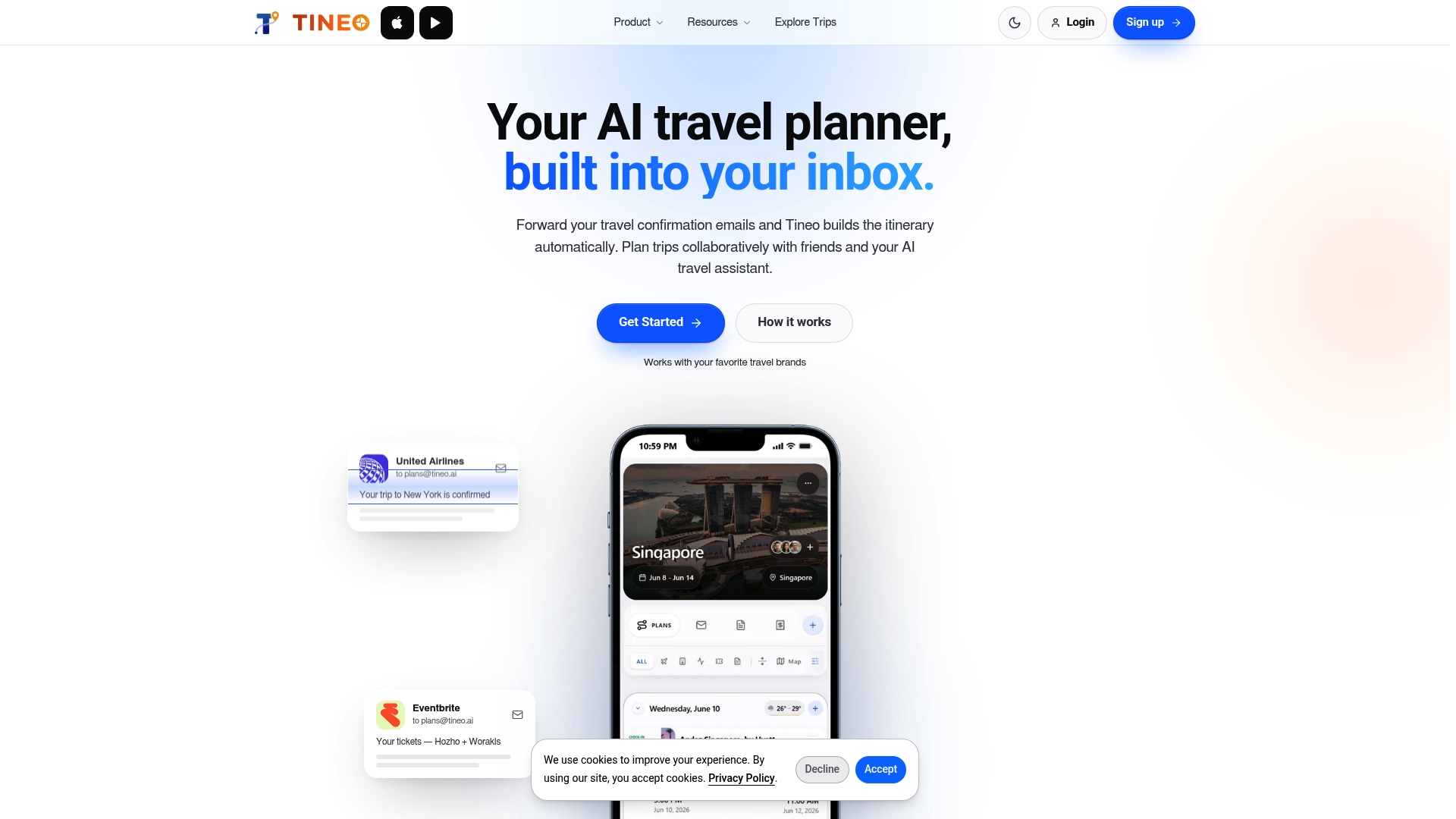
This is the part we built Tineo for. Tineo turns booking confirmation emails into an organized itinerary, so flights, lodging, car rentals, activities and other reservations sit together on one timeline. You can open the trip on web, iOS or Android, and share it with friends or family. Tineo does not book travel for you. It organizes what you have already booked, and it includes an AI travel assistant that works in the context of your trip.
If you want to see how the email side works, read our guide on turning travel emails into itineraries. If you are weighing tools, our comparison of AI travel planner apps covers the tradeoffs among several options.
Try it on your next trip
Once your AI suggestions have turned into real reservations, Tineo can bring them together. Tineo Free costs $0 per month. Tineo Ultra costs $4.99 per month or $39.99 per year and adds advanced AI capabilities, offline access, document intelligence and premium trip management tools. See the details on the Tineo pricing page, or start from the Tineo home page.
Bring your confirmations into one itinerary and share it with the people you are traveling with. Check the pricing page for the current plan details.
FAQ
Are AI trip suggestions accurate enough to book from?
Not on their own. AI is useful for ideas and rough outlines, but tests by Forbes and Outside found invented places, outdated information, wrong prices and incorrect opening times. Confirm every bookable detail with the hotel, attraction, airline or other provider before you pay.
What should I include to get better AI travel recommendations?
Include your dates, trip length, budget and currency, who is traveling, your interests and the pace you want. Add exclusions and limits too, such as no long transfers or one rest day. The more specific your brief, the less generic the suggestions.
Can AI plan a trip for a group or family?
It can draft one if you describe the whole group. Include ages, mobility needs, dietary restrictions and each person’s must-haves, then ask for a mix of shared activities and free time. Afterward, share the finished plan so everyone sees the same details.
How do I check an AI-generated itinerary?
Start with a map to confirm the order of stops and travel times. Then check opening hours and tickets on each attraction’s site, prices and cancellation terms on the hotel or provider page, and transport details with the operator. For visas and entry rules, use the official government source.
Does Tineo create trip suggestions?
Tineo is built to organize trips you have already booked. It turns confirmation emails into a shared itinerary and includes an AI travel assistant that works with your trip details. It does not book travel for you.
Sources
- AI can help you plan your next trip, if you know how to ask (National Geographic)
- Using Generative AI for Travel Inspiration and Discovery (Google Developers)
- AI Can Plan Your Next Trip. Should It? (Outside)
- My First Trip to Norway, With A.I. as a Guide (The New York Times)
- AI travel planning: plan smartly and travel safely (Europäische)
- How to use AI to plan your next vacation (MIT Technology Review)
- How Accurate Is AI For Planning Travel And Vacations? (Forbes)
- How to ask AI to create the perfect travel itinerary (RMIT University)
- How to Use AI for Planning a Trip (Seven Corners)
- Streamlining International Business Travel in 2026 (Lumo)